Under DDP, the seller clears customs and pays import duties; under DAP, the buyer handles both once the goods arrive. DDP suits B2C brands selling direct to consumers who expect an all-in price, while DAP fits established B2B importers who already run their own customs operations. One caution before you pick either: DDP is legally impossible to fulfill in some countries.
**TL;DR:** DDP requires the seller to handle import clearance, duties, and taxes, which demands local customs expertise and legal compliance in each destination country. DAP shifts responsibility for customs and duties to the buyer, making it more suitable for experienced importers and full container B2B shipments. Using DDP can lead to higher costs and operational risks for sellers, especially if local laws prohibit non-resident companies from acting as importers of record. The choice of Incoterm affects who bears cash-flow risks and faces surprise customs charges at delivery, influencing buyer conversion and logistics planning. Confirming local import regulations, VAT recovery options, and HS codes before shipment is crucial to avoid delays, costs, or legal issues for both DDP and DAP shipments.
Table of Contents
- DDP vs DAP: What Each Term Actually Requires
- DDP vs DAP Shipping: Who Pays, Who Clears, and Who Feels It
- How to Choose Between DDP and DAP for Your Shipment
- The Legal and Financial Risks Behind DDP
- Choosing Incoterms for Packaging Samples and Production Runs
- Why the “DDP Is Always Better for Buyers” Advice Falls Short
- Sources
- FAQ
DDP vs DAP: What Each Term Actually Requires
Under Incoterms® 2020, DDP (Delivered Duty Paid) is the only rule that puts import clearance and duty payment on the seller’s side of the ledger. Risk transfers to the buyer once goods arrive at the named destination, ready for unloading, but the seller has already handled export clearance, freight, import clearance, and every duty and tax along the way.
That is a heavy lift, and it comes with real operational baggage. To offer DDP credibly, a seller typically needs:
- A local customs broker in the destination country who can act on the seller’s behalf
- Possible tax registrations in that market, since import VAT is often only recoverable by whoever actually pays it
- A clear plan for currency exposure and payment timing on duties that can shift between quote and delivery
- Confirmation that the buyer will unload the shipment once it lands at the agreed location, which remains the buyer’s job even under DDP
DDP works well for luxury retail, subscription boxes, and other B2C shipments where a customer expects to pay one price and never hear from customs again. It’s why many exporters quote DDP with a markup baked in. Duty rates move, currency swings, and clearance delays all cost money, and sellers price that uncertainty into the shipment rather than absorb it after the fact.
**Pro Tip:** _Before quoting DDP on a new lane, ask your freight forwarder whether they’ve actually cleared shipments there before. A forwarder’s first attempt at an unfamiliar customs regime is not the place to discover a licensing gap._
DDP vs DAP Shipping: Who Pays, Who Clears, and Who Feels It
The landed cost is identical either way. What changes is who carries the cash-flow risk and who deals with customs on the day the shipment lands.
| Factor | DDP | DAP |
|---|---|---|
| Pays import duties/taxes | Seller | Buyer |
| Handles customs clearance | Seller | Buyer |
| Risk transfers | At named destination, before unloading | At named destination, before unloading |
| Unloading responsibility | Buyer | Buyer |
| Best for | B2C, white-glove delivery, samples to end consumers | B2B, experienced importers, recurring freight |
| Buyer experience | All-in price, no surprise fees | Possible customs bill at delivery |
Industry trade guides note that DDP shipments show buyers one all-in price, while DAP shipments can surface unexpected customs charges right at delivery. That single fact drives a lot of the conversion difference sellers report: buyers who see a clean, final number tend to complete the purchase, while a mystery duty bill at the door creates friction and abandoned deliveries.
There’s a related pattern worth flagging: sellers who move to DDP often report higher conversion for exactly that reason, but they build a markup into pricing to cover duty volatility and compliance risk. You’re not getting DDP for free. You’re paying for predictability, and so is your buyer, just earlier in the transaction.
How to Choose Between DDP and DAP for Your Shipment
Picking the right term isn’t a coin flip, it’s a short diagnostic. Work through these questions before you commit to either one:
- *Can your buyer legally act as importer of record?** If they’re an established importer with local licenses, DAP shifts clearance to the party best equipped to handle it.
- *Does the destination country allow a foreign seller to act as importer of record at all?** Some customs regimes require the importer to hold local registrations that a foreign seller simply cannot obtain, which makes DDP a non-starter regardless of what the contract says.
- *Who can recover the import VAT?** If your business has no local VAT registration in the destination market, paying that VAT under DDP may be a cost you never get back.
- *How volatile are tariffs on this product line right now?** Volatile duty schedules argue for DAP, or for a DDP quote with a wide markup and a conditional duty clause.
- *Is this a small parcel or a full container?** Small parcel and sample shipments lean DDP for convenience; full container B2B freight usually leans DAP.
Ask your broker directly: “Who is the importer of record here, and does local law allow my counterpart to hold that role?” Get that answer in writing before you quote the shipment.
If DDP turns out to be legally unworkable on a given lane, default to DAP and say so plainly in the contract. Spell out who pays demurrage and storage if customs holds the shipment, and add a clause letting either party revisit pricing if duty rates change materially between order and delivery.
**Pro Tip:** _Put the Incoterm, the named place, and the Incoterms® 2020 reference year directly on your commercial invoice and packing list. Ambiguous or missing Incoterm labeling is one of the most common causes of customs delays on both DDP and DAP shipments._
The Legal and Financial Risks Behind DDP
DDP looks simple on paper: the seller handles everything, the buyer just receives the goods. In practice, it can expose sellers to costs and legal positions they never fully priced in.
The ICC Academy warns that DDP places maximum obligation on the seller, but that obligation can become impractical where local law insists the buyer or a local entity must serve as importer of record. A contract that names the seller as responsible for import clearance doesn’t override customs law in the destination country. If that country’s regulations require a domestic importer of record, the seller’s DDP promise can’t actually be fulfilled, and the shipment stalls at the border.
VAT creates a separate trap. Import VAT is typically only recoverable by whoever pays it, so a seller with no local VAT registration in the destination market can end up eating a tax cost that a local buyer could have simply reclaimed. That’s real margin erosion on a term that was supposed to be a convenience feature.
On the DAP side, the risk runs the other way: a buyer who has never imported from a given country before can get hit with a duty bill they didn’t budget for.
Some customs regimes require the importer of record to hold local licenses or registrations that foreign sellers cannot practically obtain, which makes DDP unworkable on those trade lanes no matter what the purchase order says.
Both risks are avoidable with the same fix: confirm importer-of-record rules and VAT recovery mechanics before you finalize the Incoterm, not after the shipment is en route.
Choosing Incoterms for Packaging Samples and Production Runs
We see the DDP vs DAP decision play out differently depending on the shipment stage. Sample shipments, small boxes of rigid gift boxes or label proofs headed to a brand’s design team, usually move fastest under DDP since the volume and duty exposure are small and predictability matters more than cost.

Full production runs are a different calculation. Once you’re shipping pallets of finished cartons, labels, or carrier bags on a recurring basis, DAP often makes more sense if your brand already has an established customs broker and import process.
Whichever term you choose, confirm HS codes early, nominate a broker before the shipment leaves the factory, and agree in writing on who handles unloading at the destination dock. Coordination of documentation on production runs helps customs processes start with accurate paperwork, not guesswork. Support can range from one-off custom label orders to recurring annual packaging programs.
If you’re planning a shipment of finished rigid gift boxes or custom labels and want to talk through Incoterm choice for your specific lane, you can consult with packaging experts who can help with documentation considerations.
Why the “DDP Is Always Better for Buyers” Advice Falls Short
Most guides frame DDP as the buyer-friendly option and leave it there. That’s incomplete. DDP is buyer-convenient, not buyer-optimal, and the two aren’t the same thing.
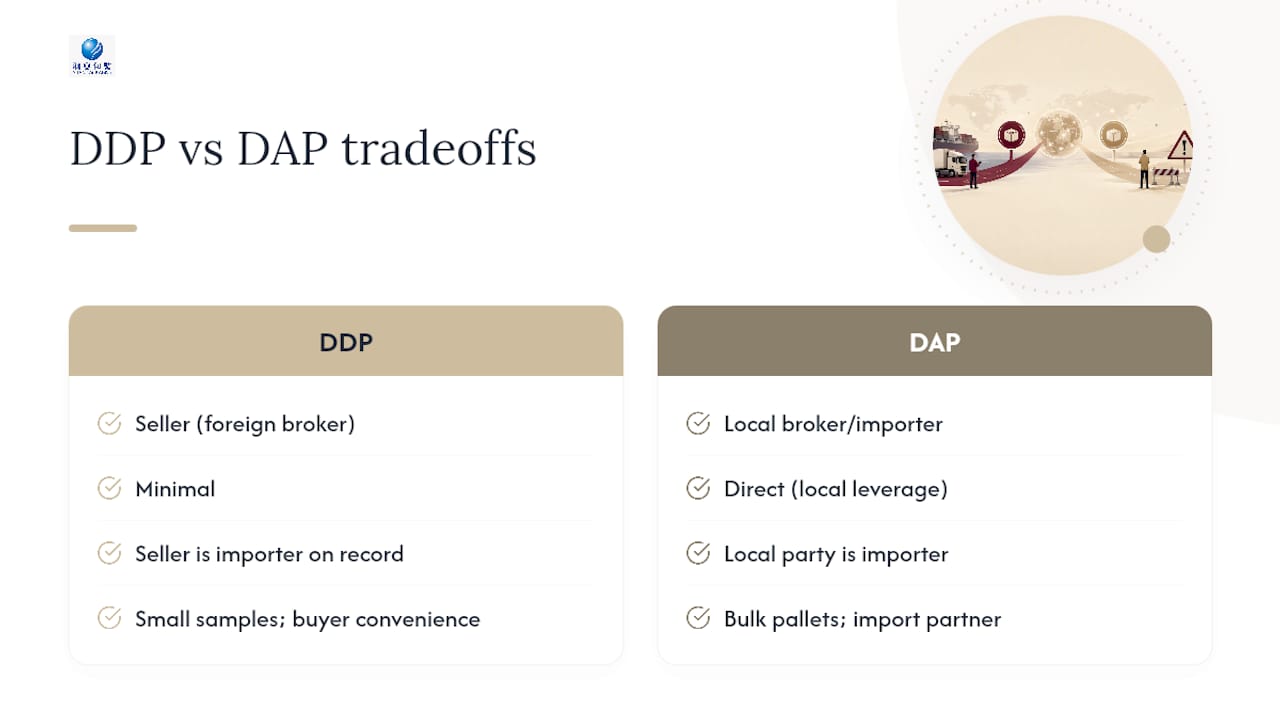
A buyer who accepts DDP is trusting a foreign seller’s customs broker, tax registration status, and legal standing as importer of record in their own country. When that seller gets the local rules wrong, the shipment sits at a border, and the buyer, who has no direct relationship with that customs authority, has almost no leverage to fix it fast. DAP keeps clearance in the hands of the party with the local license, the local broker relationship, and the standing to actually resolve a hold.
The real split isn’t “DDP is better” or “DAP is better.” It’s about who is better positioned to absorb the specific risk on that lane: duty volatility, VAT recovery, or customs delay. A brand shipping sample cartons to a design studio should take the convenience of DDP. A brand shipping ten pallets of finished packaging to an experienced import partner should let that partner clear their own goods. Treating Incoterm selection as a one-size answer is how shipments end up stuck, and how margins quietly disappear into unrecovered VAT.
_— Anthony_
Sources
Rules and obligations: Trade.gov and ICC Academy. Buyer experience and cost examples: Avalara and Inbound Logistics. Carrier handling: EasyPost.
FAQ
Is DAP Better Than DDP?
Neither is universally better. DAP shifts customs and duty responsibility to the buyer, which suits experienced importers, while DDP suits sellers who want to offer buyers a single all-in price.
Who Pays Shipping on DAP?
The seller arranges and pays for transport to the named destination under DAP. The buyer takes over once goods arrive, handling import clearance and duties.
Which Is Better for the Buyer, DDP or DAP?
DDP is more convenient for buyers since it avoids surprise customs charges at delivery, but it depends on the seller correctly handling foreign import rules, which isn’t always legally possible.
Who Pays Shipping on DDP?
The seller pays for transport, export clearance, import clearance, and all import duties and taxes under DDP, delivering the goods ready for unloading at the named place.
Can a Seller Always Offer DDP?
No. Some countries require a local importer of record, which can make DDP legally unworkable for a foreign seller regardless of contract terms.