
Packaging quality control is the structured process of inspecting, testing, and verifying that packaging materials and finished units meet defined specifications before they reach production lines or ship to customers. Done right, it protects the product inside, keeps you compliant with FDA, EU, and industry standards, and cuts returns tied to damage, mislabeling, or failed seals. The immediate move for any team building or auditing a program: define acceptance criteria in writing, and require a signed Declaration of Compliance plus a pre-production sample before the first full run.
**TL;DR:** Most packaging quality control involves visual, dimensional, functional, material, and labeling inspections at various supply chain stages to catch defects early and prevent failed shipments. Standard mechanical tests like drop, compression, and vibration are governed by specific ASTM and ISTA standards, and builders must specify exact test protocols in purchase orders for accurate validation. Acceptable Quality Level thresholds based on ISO 2859 or ANSI/ASQ Z1.4 determine sample sizes and defect limits, with escalation to full inspection if defect rates exceed 3% or regulations apply. Effective inspection workflows classify defects into critical, major, and minor categories, requiring documented findings, timestamped photos, and timely corrective actions to ensure compliance and quality. Packaging compliance for regulated sectors demands documentation like Declaration of Compliance and migration tests, with automation increasingly used for high-volume visual and dimensional checks to improve speed and accuracy.
Yuanpackaging
Explore packaging solutions
Table of Contents
- What Inspections Belong in a Packaging Quality Control Program?
- Which Mechanical Tests Prove Packaging Will Survive Shipping?
- How Do You Set Sampling and Acceptance Levels?
- Building an Inspection Workflow That Actually Closes the Loop
- What Compliance Rules Govern Regulated Packaging?
- Where Does Automation Fit in Packaging Inspection?
- How Yuan Packaging Builds QC Into the Production Process
- Why Most Teams Treat Packaging QC as an Afterthought
- Get QC-Ready Packaging Without the Guesswork
- Sources
- FAQ
What Inspections Belong in a Packaging Quality Control Program?
Packaging quality control breaks into five inspection categories, and each one answers a different question about the box, label, or bag in front of you.
- *Visual inspection** checks for scuffs, color drift, misprints, and finish defects like uneven foil stamping or lifting lamination.
- *Dimensional inspection** confirms the dieline, wall thickness, and closure tolerances match spec, usually with calipers or go/no-go gauges.
- *Functional and structural inspection** tests whether a magnetic closure actually holds, a hinge survives repeated opening, or a carrier bag handle bears its rated load.
- *Material inspection** verifies substrate weight, coating integrity, and whether the stock matches the approved FSC or recycled-content certificate.
- *Labeling inspection** confirms barcodes scan, ingredient lists match regulatory copy, and batch codes print legibly.
Map these to the supply chain: incoming inspection catches bad raw stock before it hits the line, in-line checks catch drift during a run, end-of-line inspection catches assembly errors, and pre-shipment inspection is your last checkpoint before a container leaves the factory.
Which Mechanical Tests Prove Packaging Will Survive Shipping?
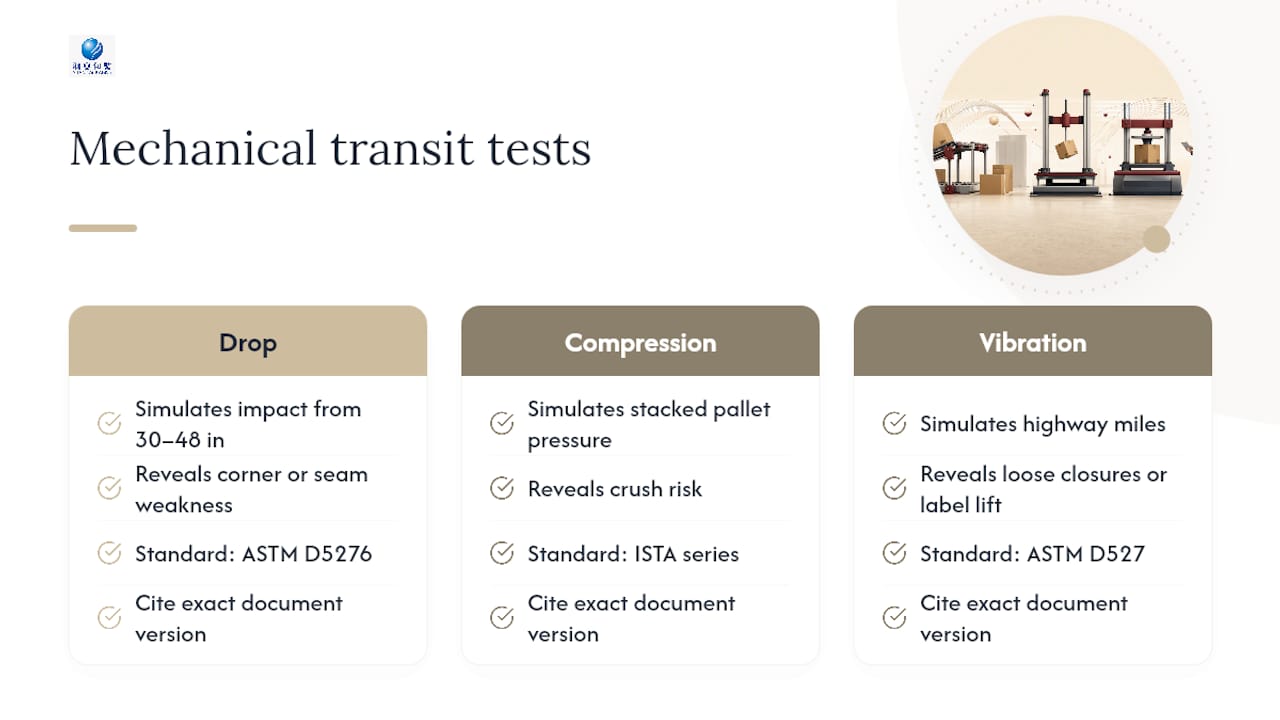
Three tests dominate packaging validation, and each simulates a different point of failure in transit. The carton drop test, typically run from heights of 30 to 48 inches depending on package weight, exposes weak corners, seam failures, and inadequate cushioning. Compression testing loads a stacked pallet’s worth of pressure onto a single case to confirm it won’t crush in a warehouse stack. Vibration testing simulates the miles of highway a shipment travels, revealing loose closures or label lift that a static test would miss.
Cite the standard, not a vague description. The ISTA test series covers simulated distribution testing, while ASTM D5276 governs drop tests and ASTM D527 addresses vibration. When a retailer or big-box buyer has its own spec, that spec overrides the generic standard, so build a clause into your purchase order that names the exact document version and acceptance threshold rather than just “ISTA testing required.” A rigid box producer should be able to hand you lab reports referencing the specific standard, not a generic pass/fail note.
How Do You Set Sampling and Acceptance Levels?
Acceptable Quality Level, or AQL, defines the maximum percentage of defective units a sample can contain before the whole lot is rejected. Most packaging programs use acceptable quality limits tailored for major and minor defects, with stricter criteria for anything touching food contact or child safety. The sampling math itself comes from ISO 2859, mirrored in the U.S. by ANSI/ASQ Z1.4, which ties your sample size to lot size rather than asking you to check every unit.
- Pull the sample size from the ISO 2859 or ANSI/ASQ Z1.4 table based on total lot quantity.
- Set separate AQL thresholds for critical, major, and minor defects rather than one blanket number.
- Escalate to 100% inspection when a supplier has a defect history above 3% on the last two shipments or when the packaging touches a regulated product.
- Add a second test protocol (drop or compression) whenever the sampling result is close to the rejection threshold.
Building an Inspection Workflow That Actually Closes the Loop
A workflow only works if it produces a decision, not just a report. Start with two KPIs: defect rate per shipment and inspection cycle time from sample pull to sign-off. Then standardize what gets checked and how a defect gets classified.
- *Critical defects**: anything creating a safety or regulatory failure, like a missing allergen warning or a tamper seal that doesn’t seal.
- *Major defects**: functional or cosmetic issues visible to the end consumer, like color mismatch or a hinge that sticks.
- *Minor defects**: small imperfections unlikely to affect sale or function, like a faint scuff on an interior panel.
Every inspection report needs timestamped photos, measured tolerances against spec, and a clear recommendation: accept, rework, or reject. When a lot fails, the corrective action process should require the supplier to submit root cause and a revised process within a fixed window, typically five to ten business days, with a follow-up inspection before the next shipment ships.
**Pro Tip:** _Build your corrective action template before you need it. A supplier under deadline pressure moves faster when the form, the timeline, and the escalation path are already spelled out, rather than negotiated mid crisis._
What Compliance Rules Govern Regulated Packaging?
Food and pharma packaging carry documentation obligations that generic consumer packaging doesn’t. Suppliers should hand over a Declaration of Compliance and migration testing data confirming the material won’t transfer harmful substances into food, a requirement rooted in FDA food-contact guidance and echoed in EU Regulation 10/2011. In the U.S., packaging inspection checkpoints belong inside your broader FSMA and HACCP plan, not bolted on separately, and GFSI-benchmarked schemes like BRC expect the same integration. Retailers add their own layer: Amazon and Walmart both enforce packaging and labeling specs that can trigger chargebacks if ignored. On the environmental side, EU packaging waste rules push producer responsibility and recyclability documentation into the same audit trail as your functional QC records.
Where Does Automation Fit in Packaging Inspection?
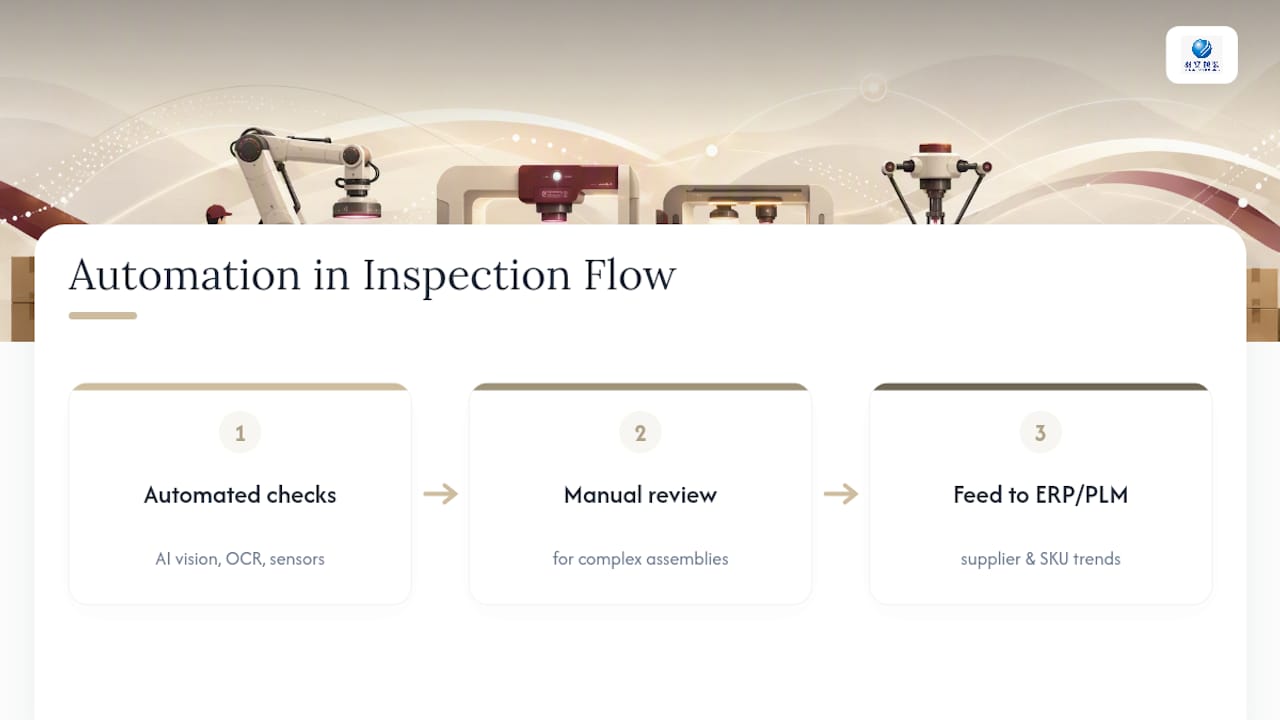
AI vision systems, OCR barcode verification, and in-line sensors now catch print defects, missing labels, and dimensional drift faster than a human eye on a high-speed line, a shift the packaging machinery industry has tracked closely. Automation earns its cost on high-volume, repeat-format runs where a camera checks every unit instead of a sample. Complex assemblies with variable components, like a rigid box with multiple inserts, still benefit from manual eyes. Whichever mix you choose, feed the data into your ERP or PLM system so defect trends by supplier and SKU show up in one dashboard instead of scattered spreadsheets.
How Yuan Packaging Builds QC Into the Production Process
Before running a full production order, it is advised to ask for documents such as a signed pre-production sample, a Declaration of Compliance, migration test reports for food-contact substrates, and proof of tamper-evident function where applicable. Pre-shipment checks on rigid boxes, pressure-sensitive labels, and closures cover dimensional tolerance, print registration, and structural load. Material sourcing should be checked against FSC and recycled-content claims at the same stage, since sustainability documentation and quality documentation increasingly belong in the same audit file.
Why Most Teams Treat Packaging QC as an Afterthought
Packaging QC usually gets attention only after a damaged shipment or a retailer chargeback forces the conversation. That’s backwards. Building acceptance criteria into the design brief, before a single prototype ships, prevents most of the disputes that surface later. This week, pull your last three supplier defect reports and set a written AQL threshold if you don’t already have one.
_— Anthony_
Get QC-Ready Packaging Without the Guesswork
Quality checkpoints can be built into every stage of production, so you’re not left reconciling a spec sheet against a finished shipment after it’s too late to fix. Unlike working with a broker who outsources inspection to whoever’s cheapest that month, in-house teams can run dimensional, functional, and material checks across rigid boxes, folding cartons, labels, and carrier bags, with documentation ready for your own audit trail.
Before reaching out, gather your specs, your required test protocols, and your target AQL level. If food or pharma contact is involved, have your migration testing requirements ready too. From there, you can request a pre-production sample, ask for a Declaration of Compliance on your specific substrate, or get a quote for your next production run. Teams working in cosmetics can also review our beauty packaging capabilities directly, and if digital proofing before physical samples matters to your approval chain, this breakdown of proof versus pre-production sample steps is worth a read first.
Sources
- FDA — Food ingredients & packaging
- European Commission — Packaging waste
- ASTM — paper and packaging standards (store)
- ISO standard listing
- VLX — Regular packaging inspection for QC and compliance
FAQ
What Are the 3 Ps of Packaging?
The 3 Ps are commonly defined as Protect, Preserve, and Present: packaging must protect the product physically, preserve its condition and shelf life, and present it in a way that supports the brand at retail.
What ASTM Standards Apply to Packaging?
ASTM D5276 covers drop testing and ASTM D527 addresses vibration testing, with the full ASTM packaging catalog listing additional material and compression standards referenced in supplier contracts.
What Are the Four Types of Quality Control?
In packaging, the four core inspection types are visual, dimensional, functional/structural, and material, each targeting a different category of defect risk.
What Are the Five Steps of Quality Control?
A typical packaging QC cycle runs: define acceptance criteria, sample the lot using AQL/ISO 2859 rules, inspect and classify defects, document findings with photos and measurements, and close out with a corrective action or lot disposition decision.
How Often Should Packaging Undergo Inspection?
Incoming materials get checked on receipt, in-line checks run continuously during production, and every lot needs a pre-shipment inspection before it leaves the factory, regardless of how clean the supplier’s track record looks.