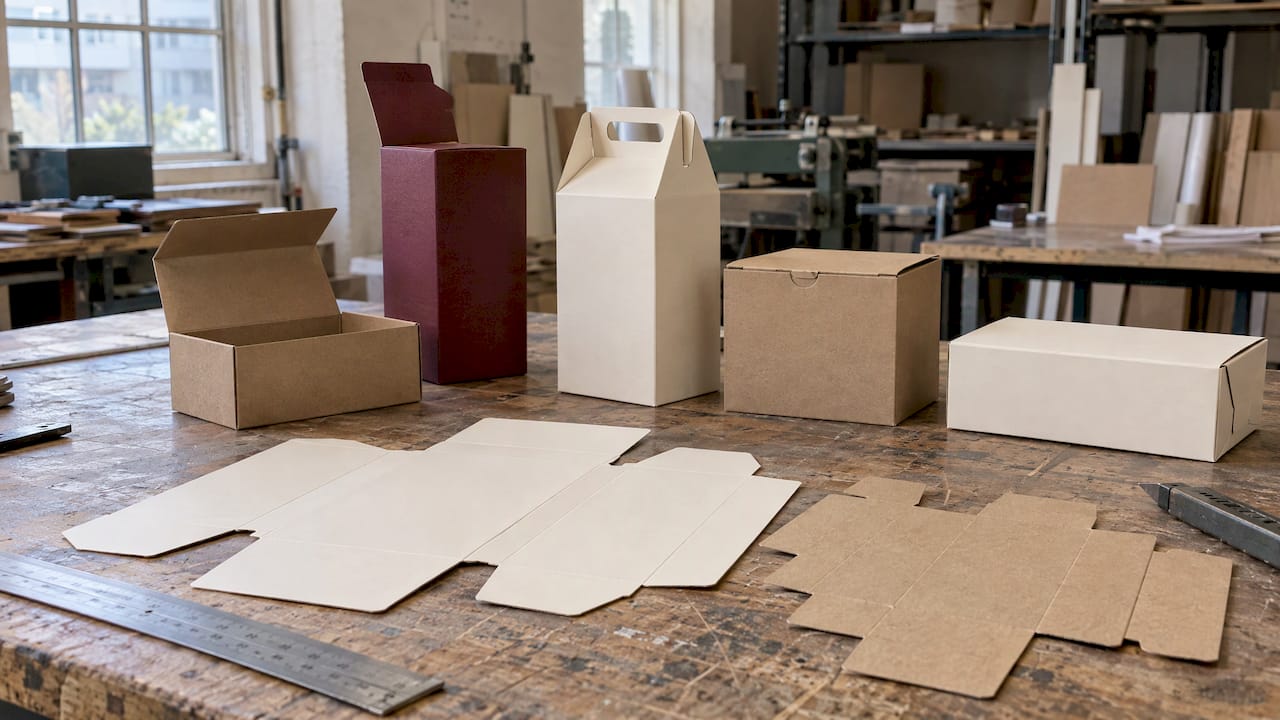
Good folding carton design starts with structure, not artwork: you choose a style that fits the product's size, weight and sales channel, build a dieline around it, and only then apply print and finishes. A folding carton is paperboard packaging that folds flat for storage and shipping, so every decision has to work twice, once as a flat sheet on press and once as a three-dimensional package on a shelf. This guide walks through the main styles, the anatomy of a dieline, material and finish choices, and the regulatory points that change by category.
TL;DR
- Pick the structure first. Tuck-end styles suit light retail products, auto-bottom styles suit heavier items and faster packing lines, and sleeves and trays suit presentation-led launches.
- A dieline is the manufacturing contract: panels, fold and cut lines, glue flaps, bleed and safe margins must all be on it before artwork begins.
- Carton dimensions are measured to the center of the fold lines, so confirm the measuring convention with your converter before you send specs.
- Cosmetics, spirits, pharmaceuticals and food each add label content and regulatory space requirements that belong in the first brief, not the last proof.
- Request a white sample on the real board before approving finishes such as foil, embossing or soft-touch lamination.
Table of Contents
- What folding carton design actually covers
- The main folding carton styles and how they close
- How to choose a style for your product
- Reading a folding carton dieline
- Using the ECMA style code as a shared language
- Materials, finishes and sustainability
- Category differences: cosmetics, spirits, pharma and food
- Our perspective
- Plan your carton with Yuan Packaging
- A spec checklist to send your converter
- FAQ
- Sources
What folding carton design actually covers
The Paperboard Packaging Council describes a folding carton as paperboard packaging designed to fold flat for storage and shipping, commonly made from roughly 10- to 36-point board in virgin, recycled or blended grades. The European standard EN 14054 makes the same point from a production angle: cartons are usually delivered to the user as flat blanks or pre-glued, flat-folded forms.
That is the main difference from a rigid box, which usually arrives fully formed and is far sturdier. Folding cartons generally trade some strength for flat shipping, lower freight cost and the ability to run at volume. If you are still deciding between the two formats, our comparison of a rigid box vs folding carton lays out the trade-offs by brand need.
Folding carton design therefore has four layers, and they should be settled in this order:
- Structure: the style, its closures and how it is assembled.
- Dieline: the flat technical drawing that translates the structure into cuts, creases and glue areas.
- Material: board type, caliper and coating.
- Graphics and finishing: print, foil, embossing, lamination and any regulatory content.
Skipping ahead, for example approving artwork before the dieline is final, is a common reason cartons need a second sample round.
The main folding carton styles and how they close
The closure decides how the carton is packed, how well it protects, and how it feels to open. The styles below cover most briefs.
Reverse tuck and French reverse tuck
The standard reverse tuck has end flaps that tuck in opposite directions: the top flap tucks toward the front panel while the bottom flap tucks toward the back. It is economical and widely used for light products. The French reverse tuck (FRT) reverses this: its top flap is hinged to the front panel and tucks toward the back, and its bottom flap is hinged to the back and tucks toward the front. The Paperboard Packaging Council notes that it gives a finished look and generous graphic space, and is often used in cosmetics, and that the double tuck-in adds protection. For skincare, fragrance sample sets and small beauty items, it is usually the first style to review. Our tuck-end cartons page shows the range we produce.

Straight tuck
In a straight tuck carton, both end flaps tuck in the same direction, so both closures sit on the same face. It is easy to assemble, gives a simple, clean look and suits lightweight products that do not need as much protection. It is sometimes called the airplane style.
Auto-lock (crash-lock) bottom
An automatic bottom is glued flat by the converter, then pops open into a locked base when the carton is erected. It carries heavier products than a tucked base, and it speeds up hand or machine packing because only the top needs closing. A tuck-top auto-bottom combination is a common choice for bottles, jars and tubes.
Snap-lock bottom
The snap-lock bottom uses interlocking panels to form a base that clicks into place with little force. It is a reasonable middle ground when you want more bottom strength than a tuck but do not need a pre-glued base, and can accept slower hand assembly than an auto-lock bottom.
Six-corner (point) trays
Six-corner trays are glued by the converter and shipped flat, and they offer high stability. The trade-off is that they can be harder to assemble than other styles, which may slow production lines. They suit products that need extra strength and a sturdy open-top or lidded display.
Sleeves and two-piece formats
A sleeve wraps an inner tray or product and slides off, which makes it ideal for presentation-led launches where the reveal matters. Two-piece formats pair a lid and base and are a natural step toward a gift-box feel without the cost and weight of a rigid structure.
Quick comparison
| Style | Best for | Assembly | Protection | Print area |
|---|---|---|---|---|
| Reverse tuck | Light, low-cost retail items | Tuck both ends | Moderate | Good |
| French reverse tuck | Cosmetics, small premium items | Double tuck | Good | Excellent |
| Straight tuck | Lightweight products | Tuck both ends, same side | Moderate | Good |
| Auto-lock bottom | Heavier items, fast packing | Pre-glued base, close top | High | Good |
| Snap-lock bottom | Mid-weight items | Base clicks into place | Good | Good |
| Six-corner tray | Products needing extra strength | Converter-glued, flat shipped | High | Good |
| Sleeve | Presentation and gift sets | Slides over tray | Depends on inner | Excellent |
The ratings are general guidance. Real performance depends on board caliper, dimensions and what is inside.
How to choose a style for your product
A style guide is only useful if it leads to a decision. Work through these questions in order.
- How heavy is the product? Light items such as a lip balm or a sachet box sit comfortably in a tuck. A glass bottle or a jar with a metal lid usually calls for an auto-lock or snap-lock bottom, or a tray, so the base does not collapse under the load.
- How is it packed? Hand-packing lines tolerate tuck closures. Automated lines usually prefer pre-glued cartons that open in a single motion, so tell your converter which machine will erect the carton.
- What does the shelf or screen need? Retail shelves reward large, uninterrupted front panels. If most sales happen online, the carton may sit inside a shipper, which shifts the priority to unboxing and to protection from the outer case. For shippers, see our guide on corrugated box design.
- How many times will it be opened? A carton opened once is a different brief from a carton the customer will reuse, for example a travel kit.
- Does it need security? Pharmaceutical and high-value products often need evidence that the pack has not been opened. Glue-seal closures and tamper-evident cartons and seals are built into the structure at this stage.
Pro tip: If two styles seem equally good, choose the one with fewer glue points and simpler erection. It will cost less to run, and it is less likely to fail on the line.
Reading a folding carton dieline
A dieline is the flat, scaled drawing of the carton showing where the press cuts and creases the board. It is the file every other decision depends on, so it deserves close attention.
Dimensions and conventions
The ECMA code of folding carton design styles defines carton size by A and B, the base dimensions, and H, the height, measured center to center of the fold or crease lines. Because these are not inside measurements, a carton built to those dimensions needs allowance for board thickness. Always state whether your product dimensions are internal, external or fold-to-fold, and confirm the convention your converter uses.
What the dieline should show
- Panels: front, back, sides, top and bottom, each labeled.
- Cut lines: the outer shape and any windows, hang holes or thumb notches.
- Crease and score lines: every fold, with direction if relevant.
- Glue flap: the area where adhesive goes, which must stay free of coatings, foil and heavy ink.
- Bleed: artwork that extends beyond the cut line, so slight movement does not leave white edges.
- Safe zone: a margin inside the cut and fold lines where text and logos stay clear of trimming and folding drift.
- Grain direction: the fiber direction of the board, which affects fold quality and stiffness.
If you also design rigid packaging, the same discipline applies. Our note on safe zones for collapsible rigid box dielines explains how margins are set, and our rigid box design guide covers the equivalent rules for that format.
Common dieline mistakes
- Placing the barcode or a key claim across a fold line.
- Running metallic foil or a varnish over the glue flap.
- Ignoring the thickness of the board when sizing the tuck flap, so the carton bulges or will not close.
- Reusing a template from a different board caliper without testing it.
- Sending artwork scaled from a flat render rather than built on the converter's own dieline.
Pro tip: Ask your converter for their dieline for the chosen style and build artwork on that file. A template from another source can differ in tuck depth, dust flap size and glue flap width.
Using the ECMA style code as a shared language
Style names vary between suppliers. One factory's "tuck top auto bottom" is another's "crash-lock". The ECMA code solves this. It sorts designs into groups: A for long-seam-glued rectangular cartons, B for non-long-seam-glued rectangular, C for long-seam-glued non-rectangular, D for non-long-seam-glued non-rectangular, E for product-related, and F for other designs. The EN 14054 standard also describes basic carton types, dimensional conventions and a style-coding system based on ECMA, and excludes corrugated and solid-board packaging.
In practice, quoting an ECMA style number alongside the common name removes ambiguity, especially when you are comparing quotes from several converters or working across countries. Add it to your spec sheet along with dimensions, board and finishes.
Materials, finishes and sustainability
Board is the foundation. The Paperboard Packaging Council notes that folding cartons can deliver high-quality graphics and have aseptic and direct food contact applications, and that an optional mini-flute construction can add protection and cushioning. They remain generally less strong than rigid boxes, so the way to get more from a carton is through correct structure and board selection rather than by adding finishes.
A useful sequence when specifying:
- Board type and caliper: heavier caliper gives a firmer feel and better stacking. Lighter board suits small, light items.
- Coating and print: coated boards give sharp color. Uncoated stocks give a natural, tactile look but absorb more ink.
- Finishes: soft-touch lamination gives a velvety surface, foil stamping adds metallic accents, and blind or debossed embossing adds relief without extra ink. Use them on the surfaces the consumer touches first, and keep them away from glue areas and folds.
- Sustainability: specify certified or recycled-content board and decide early whether plastic laminates are compatible with your recyclability claims. Document the sourcing so you can support any claim you make on pack. We source responsibly and can advise on the options.
Pro tip: Treat each finish as a production step with its own tolerances. Foil registration, emboss depth and lamination all need to be checked on a sample made from the real board.
Category differences: cosmetics, spirits, pharma and food
A carton is both a design object and a labeled product. What it must carry changes by category and by country, so confirm the rules for each market you sell into.
Cosmetics
In the United States, the FDA states that ingredient and net quantity statements apply to the label of the outer container, and that the principal display panel must show the product name, its nature or use, and the net contents. That means a French reverse tuck carton needs reserved, legible space on the front panel and enough area elsewhere for the ingredient list. Plan the hierarchy before you plan the artwork.
Spirits
Spirits cartons often carry a premium gifting role plus mandatory label content that differs by market. Because those rules vary by country, collect your importer's requirements first. Security features such as variable data or anti-counterfeit elements can be integrated through our anti-counterfeit labels and QR code labels alongside the carton.
Pharmaceuticals
Pharmaceutical cartons are the most constrained. Depending on the market, they may require leaflet space, Braille, serialization codes and tamper evidence, and the layout must leave clear zones for variable print. Our guide to pharmaceutical carton requirements covers Braille, the EU Falsified Medicines Directive and leaflets. Confirm the final text with your regulatory team before you approve a dieline.
Food and beverage
Food cartons need materials suitable for the intended contact, for example a barrier or liner where grease or moisture is involved, plus nutrition and allergen panels as required by the destination market. Ask your converter which board and coating are appropriate for direct or indirect contact and keep their documentation on file.
Our perspective
Most folding carton problems we see were decided in the first week, long before anyone looked at artwork. A brand picks a style from a mood board, then discovers the glue flap sits where the foil was meant to go, or that the tuck depth does not suit a heavier bottle.
We prefer to work in the opposite order. Settle the structure with the product in hand, build the dieline together, then choose finishes that complement the structure instead of fighting it. Our approach combines traditional hand-finishing with modern automated manufacturing, and keeping structure, print and finishing under one roof means a single team is accountable from sample to production.
The point of a premium carton is the moment the customer opens it. A well-made French reverse tuck or a precisely fitted sleeve can feel like a small ceremony, and that comes from tolerances, not decoration.
Anthony
Plan your carton with Yuan Packaging
If you have a product, a target market and a rough idea of the look, we can help you turn them into a working structure and dieline. Our custom folding cartons range covers tuck-end, auto-bottom, tray and sleeve formats, with print and finishing options such as foil stamping, embossing and soft-touch lamination, for beauty, spirits, health and food brands.
Send us your product dimensions, weight, target market and finish ideas, and we will recommend a style and prepare a sample plan. You can also browse the full product range, or see how we compare folding carton manufacturers in China.
A spec checklist to send your converter
A complete brief shortens quoting and reduces sampling rounds. Include:
- Product dimensions, weight and how the product sits in the carton.
- Preferred style, with the ECMA code if you know it.
- Board type, caliper and any certification requirements.
- Print method, color references and finishing list.
- Required regulatory text, barcodes and variable data zones.
- Packing method: hand or machine, and the machine's erection requirements.
- Quantity, delivery destination and shipping method.
- Sample requirements: white dummy, printed sample or press proof.
FAQ
What is the most common folding carton style?
The reverse tuck and the auto-lock bottom are the two workhorses. Reverse tuck cartons are economical for light products, and auto-bottom cartons carry heavier items and speed up packing. The French reverse tuck is a frequent choice in cosmetics for its finished look and room for graphics, and its double tuck adds protection.
What is the difference between a folding carton and a rigid box?
A folding carton is made from paperboard, ships flat and is erected before filling. A rigid box is built from thick board wrapped in paper and usually arrives assembled, which makes it stronger and more expensive to ship. Our rigid box vs folding carton article helps you decide by brand need.
What does a folding carton dieline need to include?
It needs every panel, cut line, crease line and glue flap, plus bleed and a safe margin for text and logos. Dimensions should state whether they are measured to fold centers, as in the ECMA convention. Ask your converter for their dieline and build artwork on top of it.
How do I choose between carton styles?
Start with the weight of the product, how it will be packed and what the shelf or shipping channel needs. Heavier items usually need an auto-lock or snap-lock bottom or a tray, while light products suit tuck ends. Then check regulatory text space for your category.
Sources
- What is Paperboard Packaging? Paperboard Packaging Council
- 5 Must-Know Folding Carton Designs, Paperboard Packaging Council
- EN 14054:2003, Design of Folding Cartons in Paper and Board
- ECMA Code of Folding Carton Design Styles
- Summary of Cosmetics Labeling Requirements, FDA
Recommended
What is the most common folding carton style?
The reverse tuck and the auto-lock bottom are the two workhorses. Reverse tuck cartons are economical for light products, and auto-bottom cartons carry heavier items and speed up packing. The French reverse tuck is a frequent choice in cosmetics for its finished look and room for graphics, and its double tuck adds protection.
What is the difference between a folding carton and a rigid box?
A folding carton is made from paperboard, ships flat and is erected before filling. A rigid box is built from thick board wrapped in paper and usually arrives assembled, which makes it stronger and more expensive to ship. Our rigid box vs folding carton article helps you decide by brand need.
What does a folding carton dieline need to include?
It needs every panel, cut line, crease line and glue flap, plus bleed and a safe margin for text and logos. Dimensions should state whether they are measured to fold centers, as in the ECMA convention. Ask your converter for their dieline and build artwork on top of it.
How do I choose between carton styles?
Start with the weight of the product, how it will be packed and what the shelf or shipping channel needs. Heavier items usually need an auto-lock or snap-lock bottom or a tray, while light products suit tuck ends. Then check regulatory text space for your category.