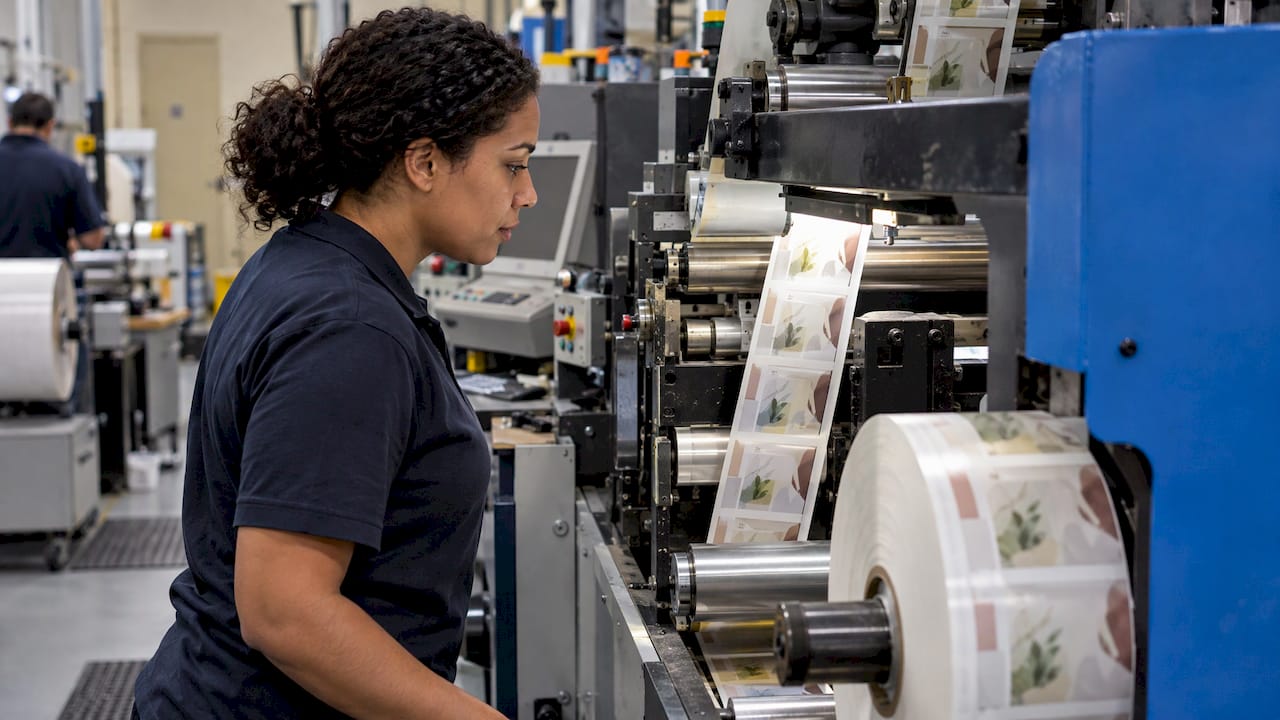
A label is the piece of paper, film or other material attached to a product to identify and describe it. On a commercial product it does two jobs at once: it carries the information a buyer needs, and it carries your brand. This guide covers the label types brands order, the materials and finishes that change how a label looks and lasts, the rules that apply in food and pharma, and the specification details to settle before you request a quote.
TL;DR
- A label informs and a logo identifies. A label gives product information and should always display your company logo, according to an Oklahoma State University Extension fact sheet.
- For premium products, the material and finish carry as much weight as the artwork. Tactile texture and deliberate finishes are central to how luxury labels are perceived.
- Match the label to the category: clear film for a "no-label" look in beauty, textured paper for wine, security features for high-value spirits, regulated content for pharma.
- Before you ask for a quote, fix the substrate, adhesive, finish, size, quantity, application method and any compliance text.
Table of Contents
- What a label does on a product
- Label types brands commonly order
- Materials: the choice buyers underestimate
- Finishes: where a label becomes premium
- Compliance: what the label must say
- How to check durability before you commit
- What to specify before you request a quote
- Our perspective
- Working with us on your labels
- Matching labels to the rest of your packaging
- FAQ
- Sources
What a label does on a product
The dictionary answer is simple: something attached to an object to say what it is. The commercial answer is broader. The same OSU Extension fact sheet describes the label as a first impression that invites purchase, one that gives product information (including mandatory elements for packaged foods) while carrying the brand's visual identity.
That is why a brand manager should think of a label as a working part of the product, not a sticker added at the end. It sits at eye level on the shelf, it is touched before the product is opened, and it is often the only printed surface on a bottle or jar.
A quick way to separate the terms you will meet in a brief:
- Label: product information plus brand identity, attached to the product or its container.
- Logo: the symbol that identifies the company. It appears on the label but is not the label.
- Brand label: a label whose primary job is identity and perception, as with a wine or fragrance front label, usually paired with a back label that holds the required information.
Label types brands commonly order
The search results for "label" mix office labels, shipping labels and clothing labels. A brand buying packaging at scale is usually choosing among a narrower set.
Pressure-sensitive labels
Pressure-sensitive (self-adhesive) labels are printed on a face material with an adhesive and a release liner, applied by pressure with no water or heat. They are the default for bottles, jars, tubes and cartons because they handle almost any shape and size and can be applied on automated lines. We explain the construction in more detail in our guide to pressure-sensitive label materials and adhesives.

Wine and spirits labels
Wine and spirits labels have to survive condensation, ice buckets and handling, and still look collectible. Typical choices include textured or laid papers, embossing, foil and clear film for a "no-label" look. Our page on custom wine and spirits labels covers what we produce, and our premium spirits label printing guide goes deeper on the process.

Cosmetic and beauty labels
Beauty packaging often sits in bathrooms and on vanities, so moisture resistance matters. According to Labels and Labeling, the health and beauty segment relies on moisture-resistant film substrates and clear polypropylene films to achieve a "no-label" look. See our cosmetic and beauty label printing page for the options we offer.
Security and anti-counterfeit labels
High-value products attract copies. The same Labels and Labeling article notes that the high-value spirits sector often adds holograms, security threads and security inks to deter theft and counterfeiting. If your product sits in that tier, look at our anti-counterfeit labels.
Pharmaceutical labels
Pharma labels are content-driven. Legibility, adhesion and exact regulatory text outrank decoration. Requirements differ by market, so the section on compliance below starts with the United States.
Materials: the choice buyers underestimate
Two labels with identical artwork can look and feel completely different depending on the stock. Material decides texture, opacity, how the label reacts to moisture and how well finishes sit on it.
| Material family | Typical use | What it gives you |
|---|---|---|
| Smooth coated paper | Food, household, general retail | Sharp print, economical, wide finish compatibility |
| Textured or laid paper | Wine, craft spirits, gourmet food | Visible fiber, tactile quality, a handmade impression |
| Clear film | Beauty, water and juice, premium bottles | The "no-label" look and moisture resistance |
| White film | Squeezable tubes, humid environments | Durability and flexibility |
| Metallized or specialty stock | Fragrance, limited editions | Built-in shine without a separate foil step |
Our journal piece on textured paper labels explains how to choose premium stocks that perform on the bottle, not just on the proof. For broader board and paper options across packaging, see our materials overview.
Matching adhesive to surface
The adhesive matters as much as the face material. Match it to three things:
- The container surface: glass, PET, HDPE, coated carton or a textured finish each behave differently.
- The environment: cold chain, ice-bucket condensation, humidity, oils from skin or contents.
- The application: hand-applied, semi-automatic or high-speed line, and the application temperature.
If your label touches food packaging and you sell into Europe, the packaging rules there can shape which substrates and adhesives you are allowed to use.
Finishes: where a label becomes premium
A luxury label rarely relies on ink alone. According to Formes de Luxe, tactile and texture effects are proving key in luxury labels, and the same report notes demand running in two directions: stripped-down naturalness on one side and strong demand for glitz, especially in fragrance, on the other. Glitz often calls for multi-material solutions.
The main finishing tools:
- Foil stamping: metallic or pigmented foil applied with heat and pressure. Labels and Labeling traces luxury and metallic effects from gold leaf to hot and cold stamping foils. Our foil stamping guide shows where it works best.
- Embossing and debossing: raised or pressed detail. Dry debossing, with no ink at all, is part of the "minimal material, but executed to perfection" direction Formes de Luxe describes.
- Spot UV: a glossy varnish on selected areas, useful for contrast against a matte field.
- Soft-touch lamination: a velvety matte surface that changes how the label feels in the hand.
- Metallic inks: a metallic look without a foil die. Our comparison of metallic inks versus foil helps you pick between them.
A full catalog of what is available is on our finishes and print effects page.
Pro Tip: Pick one hero effect per label. A single foiled mark on a textured stock reads as confident. Foil, embossing, spot UV and a metallic ink all competing on one face usually reads as noise.
Compliance: what the label must say
Decoration comes second when the label is regulated. Requirements vary by country and category, so confirm the current rules for every market you ship to. Here is the United States baseline for two categories.
Packaged food
The OSU Extension sheet cited above notes that labels for packaged foods carry mandatory elements. Because the exact list depends on the product and the jurisdiction, give your printer the final, approved text and layout rather than letting artwork decisions push required statements out of view.
Pharmaceuticals
For prescription drugs, the FDA keeps a carton and container labeling resource page listing the relevant provisions, including 21 CFR 201.100(b) for prescription labels and 21 CFR 201.10(i) for small labels. A few points that affect production directly:
- Prominence: 21 CFR 201.15 addresses how prominent required statements must be, and 21 CFR 201.1 covers the name and place of business of the manufacturer, packer or distributor, as listed on the FDA page above.
- Net quantity: under 21 CFR 201.51, a prescription drug label must declare the net quantity of contents in weight, measure or count, using prescribed terms depending on the dosage form.
- Lot numbers: under 21 CFR 201.18, the lot number should be able to yield the complete manufacturing history of the package, and an incorrect lot number may cause the product to be regarded as misbranded.
For biological products, a government excerpt lists package label items such as the proper name, manufacturer details, lot identification, expiration date, storage temperature and route of administration. Your regulatory team owns the content. Your label manufacturer should confirm that the print process can hold small type and variable data such as lot numbers and expiry dates cleanly.
How to check durability before you commit
A label that looks right on day one can still fail in transit or in a cold room. Packaging and distribution testing, as described by Pace Life Sciences, checks legibility, adhesion and durability through temperature and humidity exposure, peel resistance and abrasion testing. It references standards such as ASTM D6252 for 90° peel adhesion of pressure-sensitive label stocks and ASTM D5264 for abrasion resistance with a Sutherland rub tester.

You do not need a lab for every project, but you should write down the conditions your product meets: refrigeration, ice-bath chilling, hot fill, shipping in humid containers, repeated handling. Put them in the brief so the stock and adhesive are chosen for them.
What to specify before you request a quote
Good quotes come from complete briefs. Use this checklist.
- Product and container: material, shape, diameter, label panel dimensions and any curvature or ridges.
- Label type: single front label, front and back, wrap, neck label or seal.
- Substrate: paper, textured paper or film, with an opacity or transparency requirement.
- Adhesive: permanent or removable, and the conditions it must survive.
- Print method and colors: number of colors, brand color references, any special inks.
- Finishes: foil, emboss, deboss, spot UV, soft-touch, with artwork layers marked for each.
- Security features: if the product is high value or at risk of copying.
- Compliance content: final approved text, barcodes, lot and expiry fields, language versions.
- Quantity and run structure: total volume, number of versions, reorder rhythm.
- Application method: hand, semi-automatic or line speed, and the roll specification your equipment needs (core size, unwind direction, outer diameter).
- Sustainability requirements: for example FSC-certified paper, if your retail partners ask for it.
- Timeline: launch date, and the lead time for samples, approval and production.
Key Takeaway: The three details that most often change a quote are the substrate, the number of finishes and the number of versions. Settle them first.
Our perspective
We have spent more than 25 years producing labels and packaging for beauty, wine, spirits, pharmaceutical and gourmet brands, and the pattern is consistent: the labels that perform best were specified early, with the container, the finish and the filling line all considered together.
Too many projects start with artwork and treat the material as an afterthought. We prefer to start with the surface and the story. What does the bottle feel like in the hand? What should the label say before anyone reads it? From there, the stock, the adhesive and the finishing follow naturally.
Our approach is atelier-like by design: precise production, tailored options such as foil stamping, embossing, spot UV and soft-touch lamination, and expert guidance from concept to finished product. If you need a specific certification such as FSC, tell us at the start so it shapes the material choice from day one.
A label is a small ceremony. It is the first thing your customer touches, and it deserves to be made as carefully as the product it sits on.
Anthony
Working with us on your labels
Yuan Packaging is a custom packaging manufacturer based in Huai'an, China, producing pressure-sensitive labels, rigid gift boxes, carrier bags and folding cartons for global brands. If you are planning a label project, our custom pressure-sensitive label page is the place to start, and our wine and spirits label range covers the most requested premium formats.
Send us your container details, quantities and finish ideas, and we will guide you from concept to finished product. You can reach us through our contact page.
Matching labels to the rest of your packaging
Labels rarely work alone. A wine label on a bottle shares a shelf with a carton, a gift carrier and often a tissue wrap, and these pieces should read as one system. Our guide to wine and spirits packaging shows how labels, boxes and carriers fit together. For gifting, consider bottle and gift set carrier bags or custom printed tissue paper that echo the label's palette and finish.
A useful rule: repeat one material or finish across the system rather than every effect. If the label uses a gold foil mark, use the same gold on the carton or the tissue, and let the paper textures complement each other.
FAQ
What is a brand label?
A brand label is a label designed to carry the brand's visual identity as well as product information. It should always display the company's logo, which on its own only identifies the company, as the OSU Extension fact sheet explains. On premium products it is usually paired with a back label for required information.
Where can I find custom labels for my products?
Brands ordering at scale usually work with a custom label manufacturer that can match material, adhesive and finishes to the product. We make custom pressure-sensitive labels for beauty, wine, spirits, pharmaceutical and gourmet brands. Send your container dimensions, quantity and finish ideas to start.
Which label material is best for beauty products?
Beauty products are often exposed to moisture, so moisture-resistant film is a common choice. Labels and Labeling notes that the health and beauty segment uses clear polypropylene films to create a "no-label" look. Add finishes such as soft-touch lamination or foil to give the label tactile depth.
How do I make a label look premium?
Start with the stock, then add one or two deliberate finishes. Textured paper, dry debossing and foil are common routes, and Formes de Luxe reports that tactile effects are key in luxury labels. Restraint usually looks more expensive than adding every effect.
Sources
- Logos vs. Labels: What's the Difference? (OSU Extension)
- How are label trends and innovations elevating luxury packaging (Formes de Luxe)
- Exploring the opportunities to add value to labels (Labels and Labeling)
- Carton and Container Labeling Resources (FDA)
- 21 CFR Part 201, Labeling (eCFR)
- Extracted Pages, biological product labels (reginfo.gov)
- Packaging and Distribution Testing (Pace Life Sciences)