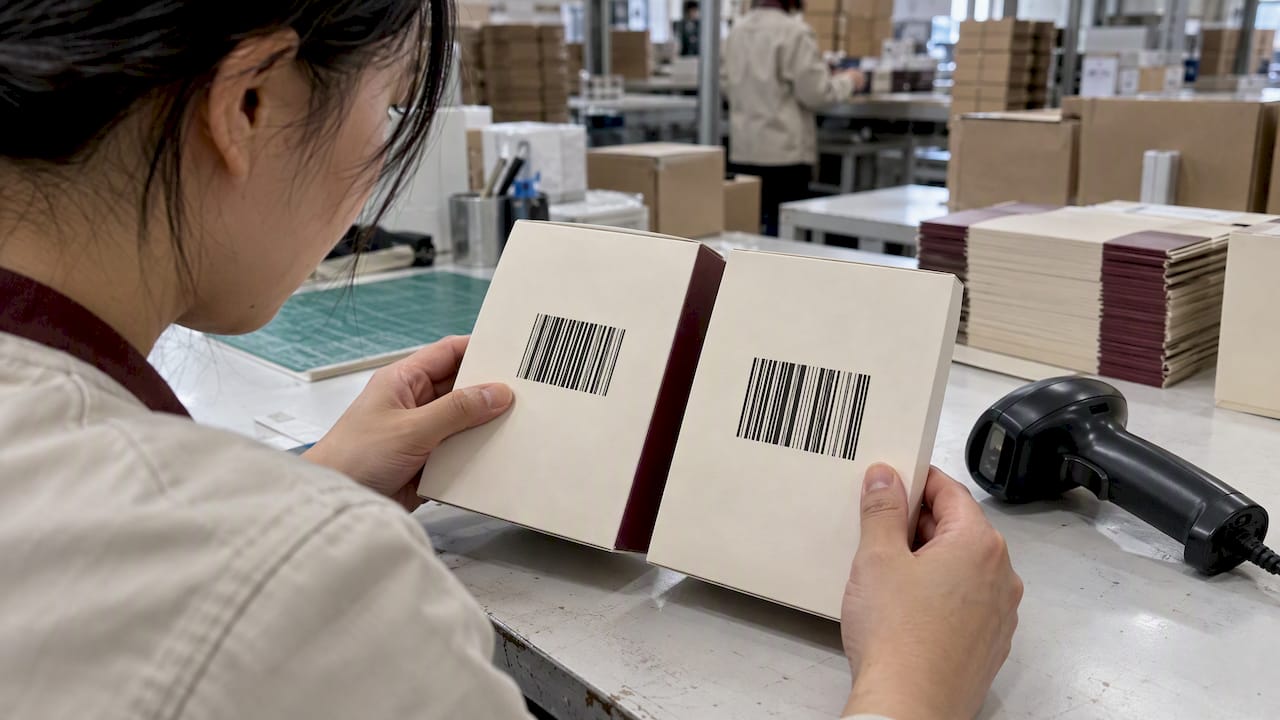
A UPC is a 12-digit retail barcode (GTIN-12) built for North America. An EAN is a 13-digit retail barcode (GTIN-13) used by retailers across much of the rest of the world. Both identify a product at the point of sale, both come from the same GS1 numbering system, and for most brands the practical question is not which one is better. It is which one your retail partners expect, and how to place it correctly on a carton, label or box before the artwork is final.
This guide explains how the two formats differ, when each one is the right choice, what the small compressed versions are for, and where barcode decisions meet packaging production.
TL;DR
- UPC is the 12-digit GTIN-12 standard in North America. EAN is the 13-digit GTIN-13 used for products sold mainly outside North America.
- They are regional adaptations of one GS1 standard, not rival systems, and most retail systems now read both. Always confirm with each retailer, because some buying guides accept only one.
- You do not choose a barcode by manufacturing location. You license a GS1 Company Prefix, and the numbers you assign from it become your GTINs.
- UPC and EAN are for retail scanning only. Cases and pallets use ITF-14 or GS1-128, and richer product data calls for a 2D code.
- Settle the barcode type, size and quiet zone before the dieline is locked, so the code survives foil, embossing and lamination.
Table of Contents
- What a UPC and an EAN actually are
- How UPC and EAN differ
- Are they interchangeable?
- Can you convert an EAN to a UPC?
- Where the numbers come from
- Barcodes do not show where a product was made
- Small packs: UPC-E and EAN-8
- Retail codes versus shipping codes
- When a 1D barcode is not enough
- Placing the barcode on premium packaging
- A short checklist before artwork approval
- Our perspective: treat the barcode as part of the structure
- Getting the barcode right on your next run
- FAQ
- Sources
What a UPC and an EAN actually are
The Universal Product Code (UPC) and the European Article Number (EAN) are two ways of printing a Global Trade Item Number (GTIN) as a scannable symbol. GS1 draws a useful line here: in its system there is the data, which is the GTIN, and there is the data carrier, which is the barcode that holds it. GS1 US explains that people often use "UPC", "GTIN" and "barcode" interchangeably, though they are not the same thing.
The naming maps to length. GS1's support portal describes GTIN-12 as the UPC, mostly used in North America, and GTIN-13 as the EAN. The EAN name itself has changed: it began as European Article Number and is now formally the International Article Number, though almost everyone still says EAN.
In practice, the symbols you will see on a shelf are:
| Symbol | Digits | Typical region | Notes |
|---|---|---|---|
| UPC-A | 12 | North America | The standard retail barcode on everyday goods |
| UPC-E | 8 (compressed) | North America | For packs with too little room for a full UPC-A |
| EAN-13 | 13 | Most of the world outside North America | Identifies products at retail point of sale |
| EAN-8 | 8 | Global | Used on small items such as cosmetics, chewing gum and cigarettes |
The compressed formats come from GS1 US's comparison of EAN and UPC, which also confirms that they scan the same way as their full-length counterparts.
How UPC and EAN differ
At a glance the two look identical. The differences are small but real.
Length and number structure
An EAN is one digit longer than a UPC, and GS1 US notes that this changes how the digits are laid out. A UPC-A carries 12 digits, and an EAN-13 carries 13. Because a 12-digit UPC can be written as a 13-digit number with a leading zero, many systems store both in the same field, which is one reason software treats them as interchangeable.
Where the check digit sits
The human-readable numbers under the bars are the quickest tell. Per GS1 US, a UPC has a trailing check digit set on the right side of the bars, while an EAN keeps its check digit inside the bars. If you are reviewing artwork and need to know which type a designer placed, look at the digit positions under the symbol.
Where each is used
GS1 US describes the UPC as the standard for retail products in North America, and the EAN as the standard for products sold mainly elsewhere. Neither is more modern or more reliable than the other. They are regional habits of one system.
Are they interchangeable?
Mostly, yes, with one honest caveat.
GS1 states that EAN and UPC formats are accepted globally, but that a retailer's local buying guide may accept only one symbol type. GS1's advice is to check with your trading partners. Behind that sits a bigger shift: after the EAN/UCC Sunrise 2005 initiative, trading partners updated their systems so that most retail systems now support both formats, regardless of origin.
So the working rule is simple:
- If you sell mainly in the U.S. and Canada, a UPC-A is the expected format.
- If you sell mainly in Europe, Asia or other regions, an EAN-13 is the expected format.
- If you sell in both, ask your largest retail partners which one they want on the pack, and get it in writing before artwork approval.
Pro tip: Marketplaces and retailer portals often ask for the GTIN as a number in a data field, not for a particular symbol. The number you license is what matters most. The symbol is how it gets printed.
Can you convert an EAN to a UPC?
This is one of the most common questions, and the answer depends on what you mean. A UPC-A and the EAN-13 that begins with a zero describe the same product number, so a brand that holds a U.S. prefix usually has both forms from one set of digits. What you cannot do is invent a new UPC from an unrelated EAN by dropping a digit. Every GTIN is built from a licensed company prefix, and a made-up or truncated number will fail verification or, worse, collide with another company's product.
If you want one set of numbers for global trade, license your prefix once, assign item numbers from it, and print the format each market expects.

Where the numbers come from
Barcodes do not appear from a design file. A brand must license a unique GS1 Company Prefix from its local GS1 Member Organization, and then assign item numbers within that prefix. Buying a single code from a reseller is a shortcut, and it can create trouble when a retailer checks who owns the number.
For U.S. brands, GS1 US publishes its fees. According to the GS1 US Company Prefix store page, a prefix covering 1 to 10 products carries a $250 initial fee and a $50 annual renewal, while 1 to 100 products costs $750 initially and $150 a year. The page notes that GS1 US can change its pricing, so check it before budgeting.
Two planning points matter here:
- Count your variants. A single style in four colors and four sizes needs 16 GTINs, as the store page explains. Plan capacity for the next one to two years of range growth.
- Never reuse a number. According to SPS Commerce's item identifier guidance, GTINs may not be reused once assigned, even when the product is discontinued. Keep a clean master list.
Barcodes do not show where a product was made
A persistent myth is that the first digits reveal the manufacturing country. GS1 US has addressed this directly: the company prefix reflects the Member Organization where the company licensed it, often tied to headquarters, not to where goods are made. A brand with a U.S. prefix can produce anywhere. It is worth knowing if your customers ask why a UPC sits on a product made overseas.
Small packs: UPC-E and EAN-8
Lip balms, sample vials, mini fragrance bottles and slim tubes often cannot hold a full-size symbol. The compressed UPC-E (8 digits, for North America) and EAN-8 (8 digits, used globally on small items) exist for this reason, and GS1 US says they function exactly like the full-length codes at the scanner.
Before you reach for a compressed code, check two things. First, whether your retailer accepts it. Second, whether shrinking the full code would be better handled by rethinking the layout, such as moving the barcode to a flat panel on a tube or a hang tag. Compressed codes are for genuine space limits, not for design preference.
Retail codes versus shipping codes
UPC and EAN identify products at the register. They are not meant for the outer case. GS1 US's ITF-14 guidance states that ITF-14 is used to mark cases, cartons and pallets rather than items sold at retail point of sale. For logistics data you can also use GS1-128, which carries more than a bare product number.
The practical split for a packaging program:
- Unit pack (carton, label, tube, rigid box): UPC-A or EAN-13.
- Master case or shipper: ITF-14 or GS1-128, printed on a corrugated surface that tolerates handling. Our corrugated and e-commerce boxes are made with this separation in mind.
- Pallet: GS1-128 or a pallet label with the logistics data your distributor asks for.
When a 1D barcode is not enough
A UPC or EAN tells a scanner which product it is looking at. It does not say which batch, when it expires or where it was filled. Practitioners add supplementary data carriers to handle this. GS1 add-on symbols cannot do this job: they are 2- or 5-digit supplements used mainly on periodicals and books. Batch and expiry data are encoded with GS1 Application Identifiers in GS1-128 or in 2D codes such as GS1 DataMatrix and QR, which brands in spirits and pharmaceuticals often move to for dynamic supply chain information.
The direction of travel is clear. GS1 US reports that 82% of retailers and 92% of brand owners surveyed support moving from traditional 1D barcodes to data-rich 2D barcodes. A 1D barcode cannot be upgraded to carry that extra data, so the usual approach is to keep the UPC or EAN for the register and add a 2D code beside it for traceability and consumer storytelling.
If you are weighing that step, these guides cover the production side:
- Data Matrix vs QR Code: size, GS1 rules and print tolerance
- GS1 compliant variable data labels
- QR code labels for premium packaging
Placing the barcode on premium packaging
This is where the UPC versus EAN choice becomes a manufacturing question. A barcode is a printed object with a size, a quiet zone and a contrast requirement, and premium finishes can interfere with all three.
Keep the code on a plain, matte-friendly zone
Foil stamping, embossing and high-gloss spot varnish are beautiful on a brand mark and unhelpful under a scanner. Keep the barcode panel free of foil and emboss, and give it a flat, high-contrast background: dark bars on a light field. Soft-touch lamination is generally fine for scanning, but test it, since some coatings alter reflectance.

Reserve the quiet zone in the dieline
Every symbol needs clear space on both sides. Decide the barcode type first, because the EAN-13 and UPC-A have different widths and quiet zone margins. Set the panel in the dieline before the creative team fills the surrounding space. Our guide to rigid box design, dielines and production rules shows how we plan panels early.
Choose the right carrier for each pack type
- Folding cartons: print directly on the back or base panel. See custom folding cartons.
- Rigid gift boxes: the wrapped paper is often textured or foiled, so a separate pressure-sensitive label on the base is the safer carrier. See rigid gift boxes.
- Bottles, jars and tubes: a custom label lets you place the code on a flat area away from curves.
- Hang tags and sleeves: useful for small accessories, where a full code will not fit on the product.
Spirits and pharmaceuticals
Regulated categories add rules on top of the retail barcode. Spirits brands often pair a standard code with anti-counterfeit or track-and-trace features, and pharmaceutical cartons carry their own coding requirements. Our guides to label printing for premium spirits, track and trace labels that survive lamination and pharmaceutical carton requirements go deeper on those.
A short checklist before artwork approval
- Confirm the target markets and which symbol each retailer requires.
- License your GS1 Company Prefix and build a master list of GTINs, one per variant.
- Decide whether any pack needs UPC-E or EAN-8, and confirm retailer acceptance.
- Assign ITF-14 or GS1-128 for cases and pallets.
- Decide whether a 2D code belongs next to the retail barcode.
- Lock the barcode panel, quiet zone and substrate in the dieline.
- Approve a physical proof and scan it before the full run.
Our perspective: treat the barcode as part of the structure
In our experience, barcode problems rarely come from choosing the wrong standard. They come from late decisions. A creative team signs off a beautiful foil-heavy carton, and only afterward does someone ask where the code goes, which leaves the barcode squeezed onto whatever space remains.
We approach it the other way around. At our single facility, we combine hand-finishing craft with automated production, so a premium finish and a scannable code are planned together, not traded against each other. We ask three questions at the start of a project: which markets will this ship to, which carrier will hold the code, and does the pack need more than a retail identifier. Answering them early costs a conversation. Answering them after printing can cost a reprint.
For most brands we speak with, the guidance is plain. Use the format your retailers ask for, license your numbers properly, keep the code away from foil and emboss, and put traceability data in a 2D code instead of trying to stretch a 1D symbol beyond what it can do.
— Anthony
Getting the barcode right on your next run
If you are preparing a new carton, label or gift box, send us your target markets and GTIN list along with the artwork. We will review the barcode panel, finish plan and substrate together, and advise on the right carrier before anything goes to press. Explore our full range of custom packaging and labels, or see our variable data and serialized labels if your pack needs unit-level coding.
FAQ
Should I use EAN or UPC?
Use the one your retail partners require, which usually follows where you sell. UPC-A is the expected format in North America, and EAN-13 is expected in most other regions. GS1 says the two are accepted globally but that a local buying guide may accept only one, so confirm with each retailer.
Is an EAN the same as a UPC?
They are closely related but not identical. Both are GTINs from the GS1 system, and both identify products at retail point of sale. A UPC has 12 digits, an EAN has 13, and the check digit is placed differently, so the symbols are not the same printed object.
Can you convert an EAN to a UPC?
Only when both come from the same licensed company prefix, such as a U.S. prefix that can be written in both forms. You cannot create a valid UPC by cutting digits off an unrelated EAN. License your prefix once and generate each number from it.
Do UPC and EAN barcodes show where a product is made?
No. GS1 US states that the prefix reflects where the company licensed it, which is often its headquarters, not the factory. Brands can manufacture anywhere and still use the same prefix.
Can I put a UPC or EAN on a shipping case?
It is not the right tool. GS1 US says ITF-14 is used for cases, cartons and pallets instead, because retail barcodes are designed for scanning at the register. Use ITF-14 or GS1-128 for logistics labeling.
Sources
- EAN Numbers and UPCs: What is the Difference? (GS1 US)
- What is a GTIN? (GS1 US)
- GS1 Support: GTIN, barcode, EAN and UPC
- GS1 Support: Are EAN-13, UPC-A, EAN-8 and UPC-E accepted worldwide?
- GS1 US Company Prefix pricing
- Fact: U.P.C. Barcodes Don't Reveal Product Manufacturing (GS1 US)
- What is an ITF-14 Barcode? (GS1 US)
- Item Identifiers (SPS Commerce Fulfillment Help Center)
- GS1 add-on symbol specification
Recommended
- Data Matrix vs QR Code: Size, GS1 Rules and Print Tolerance
- Variable Data Label Printing: GS1 Barcodes, Serialization and QC
- QR Code Labels for Premium Packaging: A Production Guide
- Variable Data & Serialised Labels
Should I use EAN or UPC?
Use the one your retail partners require, which usually follows where you sell. UPC-A is the expected format in North America, and EAN-13 is expected in most other regions. GS1 says the two are accepted globally but that a local buying guide may accept only one, so confirm with each retailer.
Is an EAN the same as a UPC?
They are closely related but not identical. Both are GTINs from the GS1 system, and both identify products at retail point of sale. A UPC has 12 digits, an EAN has 13, and the check digit is placed differently, so the symbols are not the same printed object.
Can you convert an EAN to a UPC?
Only when both come from the same licensed company prefix, such as a U.S. prefix that can be written in both forms. You cannot create a valid UPC by cutting digits off an unrelated EAN. License your prefix once and generate each number from it.
Do UPC and EAN barcodes show where a product is made?
No. GS1 US states that the prefix reflects where the company licensed it, which is often its headquarters, not the factory. Brands can manufacture anywhere and still use the same prefix.
Can I put a UPC or EAN on a shipping case?
It is not the right tool. GS1 US says ITF-14 is used for cases, cartons and pallets instead, because retail barcodes are designed for scanning at the register. Use ITF-14 or GS1-128 for logistics labeling.