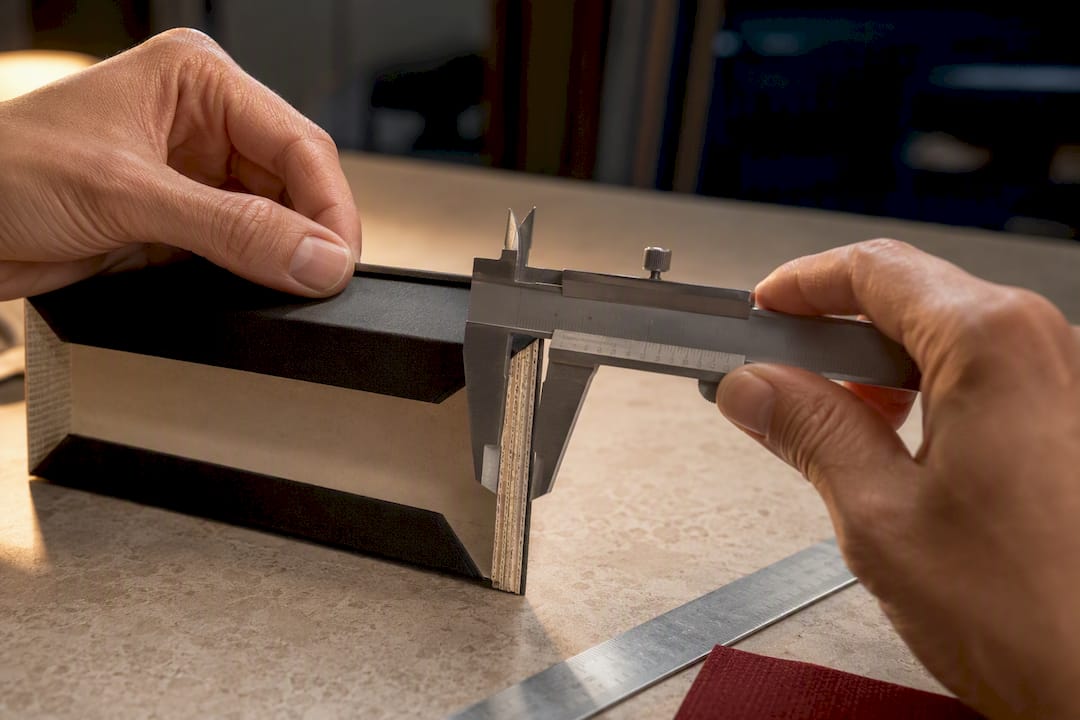
Three specs decide whether your custom rigid gift box fits right the first time: internal product length, width, and height (with orientation and clearance built in), your preferred board thickness (2 to 4 millimeters), and your construction style. Confirm all three against a pre-production sample before committing to a production run. **Yuanpackaging** builds every quote around these fields, because guessing at any one of them is what turns a launch date into a reprint.
**TL;DR:** Accurate internal product measurements and preferred construction details must be provided before requesting a quote to avoid delays and reprints. Clearances vary by product type, ranging from 1 to 15 millimeters, with tighter tolerances needed for irregular or delicate shapes. Using a board thickness of 2 to 3 millimeters suits lighter items, while 3 to 4 millimeters is recommended for heavier or high-impact products. Construction style influences internal sizing, with options like magnetic closures or collapsible designs requiring specific dieline adjustments. One sample approval is typically sufficient when all dimensions and specifications are clearly defined upfront; incomplete info often leads to multiple revision rounds.
Yuanpackaging
Explore Yuan Packaging
Table of Contents
- What Goes on an RFQ for Custom Rigid Gift Boxes?
- How Do You Measure Products and Calculate Clearance?
- How Thick Should the Board Be for Your Product?
- Which Construction Style Changes Your Box’s Sizing?
- What Belongs on a Production-Ready Dieline?
- How Do Order Quantity and Sampling Affect Your Timeline?
- What QC Checks Prevent Sizing Rework?
- What Are Standard Gift Box Sizes by Product Category?
- How Does Box Size Affect Shipping Costs?
- How Do You Size Boxes for Irregular or Delicate Products?
- Who Provides What at RFQ: Buyer vs. Supplier Responsibilities
- Why Following the RFQ Checklist Actually Reduces Launch Risk
- Ready to Turn These Specs Into a Sample?
- Sources
- FAQ
What Goes on an RFQ for Custom Rigid Gift Boxes?
A supplier can’t quote what it can’t see. Suppliers generally need internal dimensions, board weight, wrap material, print method, finishes, and quantity before they can price a job accurately, and rigid box manufacturers work the same way. Send these fields together, and you cut the back-and-forth that eats weeks off a launch timeline.
**Copy this into your next RFQ:**
- Internal L x W x H, in millimeters, plus product orientation (standing, lying flat, nested)
- Insert type and thickness (foam, molded pulp, cardboard divider)
- Wrap material and finish (matte, gloss, soft-touch, textured)
- Color specification: Pantone/PMS numbers or CMYK build
- Expected order quantity, including any reorder projections
- Required dimensional tolerances
- Dieline file format (vector, with bleed and fold lines marked)
Clearance depends heavily on what’s going inside:
- Jewelry and small accessories: 1 to 3 millimeters
- Cosmetics jars, compacts, and tubes: 2 to 5 millimeters
- Multi-piece gift sets: 5 to 15 millimeters
- Bottles (spirits, fragrance): larger allowances, sized to neck and shoulder geometry
Work in millimeters, not inches. Rigid box tooling is engineered in metric units globally, and mixing systems is a common source of dieline errors.
How Do You Measure Products and Calculate Clearance?
Getting the internal cavity right starts with the product itself, not the box.
- *Measure the finished product** at its widest points, including any labels, closures, or packaging accessories that ship attached to it.
- *Lock in orientation.** A standing perfume bottle needs different internal height than one packed on its side. Decide this before you touch a dieline.
- *Add insert or liner thickness** to your raw product dimensions. A 4 millimeter foam divider adds 8 millimeters across two walls, not just 4.
- *Apply clearance margins** appropriate to the category (see the ranges above). Too little clearance jams inserts on assembly lines; too much lets product shift and scuff in transit.
Irregular shapes (a curved decanter, a multi-textured skincare set) don’t measure cleanly with a tape measure. Build a foam mock-up or, for higher-value runs, a 3D scan, and derive the dieline from that model rather than estimated calipers.
**Pro Tip:** _Foil stamping, embossing, and spot UV all add physical thickness to a panel. A deep emboss can shave a millimeter or more off effective internal clearance. Specify finish depth to your supplier before finalizing internal dimensions, not after the sample arrives too tight._
How Thick Should the Board Be for Your Product?
Board thickness is a protection decision, not a cosmetic one. Rigid boxes typically use greyboard cores 2 to 4 millimeters thick, and the right number depends on what’s riding inside and how far it’s traveling.
- *2 to 3 millimeters:** Light goods such as single cosmetics units, jewelry, or candles where the box is handled gently and shipped in secondary cartons.
- *3 to 4 millimeters:** Spirits bottles, multi-piece gift sets, and anything with real weight or drop risk during last-mile delivery.
Thicker board isn’t free. Every added millimeter increases material cost and shipping weight, and freight is charged on both dimension and mass. A 4 millimeter core across a large box footprint can meaningfully change your per-unit landed cost compared to 2.5 millimeters, so don’t over-spec out of caution alone.
If your product travels long distances, changes hands multiple times, or faces rough parcel-network handling, up-spec the board even if the item itself is light. A delicate glass bottle surviving a short regional route and one surviving three transfer points across international freight need different structural margins, even at the same weight.
Right-sizing the box to eliminate dead space cuts material waste and supports sustainability goals without weakening protection.
Which Construction Style Changes Your Box’s Sizing?
The construction you choose reshapes both the internal cavity and the dieline itself.
- *Two-piece (base and lid):** Simplest structure. Lid depth needs its own clearance calculation, separate from the base, so the product isn’t gripped or crushed when the lid seats.
- *Magnetic closure:** Requires a folded flap with embedded magnets, which adds thickness to one panel and needs alignment tolerance in the dieline so the magnets meet cleanly every time.
- *Sleeve and tray:** The sleeve’s internal dimensions must clear the tray’s outer dimensions with enough margin to slide smoothly, but not so much that the sleeve slips loose in transit.
- *Collapsible rigid boxes:** Fold lines replace glued corners in places, which changes how much waste allowance and reinforcement the dieline needs at stress points.
Wrap tension and edge finishing also affect how forgiving a construction is. A magnetic closure with a tight wrap shows every corner imperfection; a collapsible structure hides minor variance in its folds. If warehouse space or freight volume is a priority, collapsible and sleeve styles ship flatter and cut cubic volume before assembly.
What Belongs on a Production-Ready Dieline?
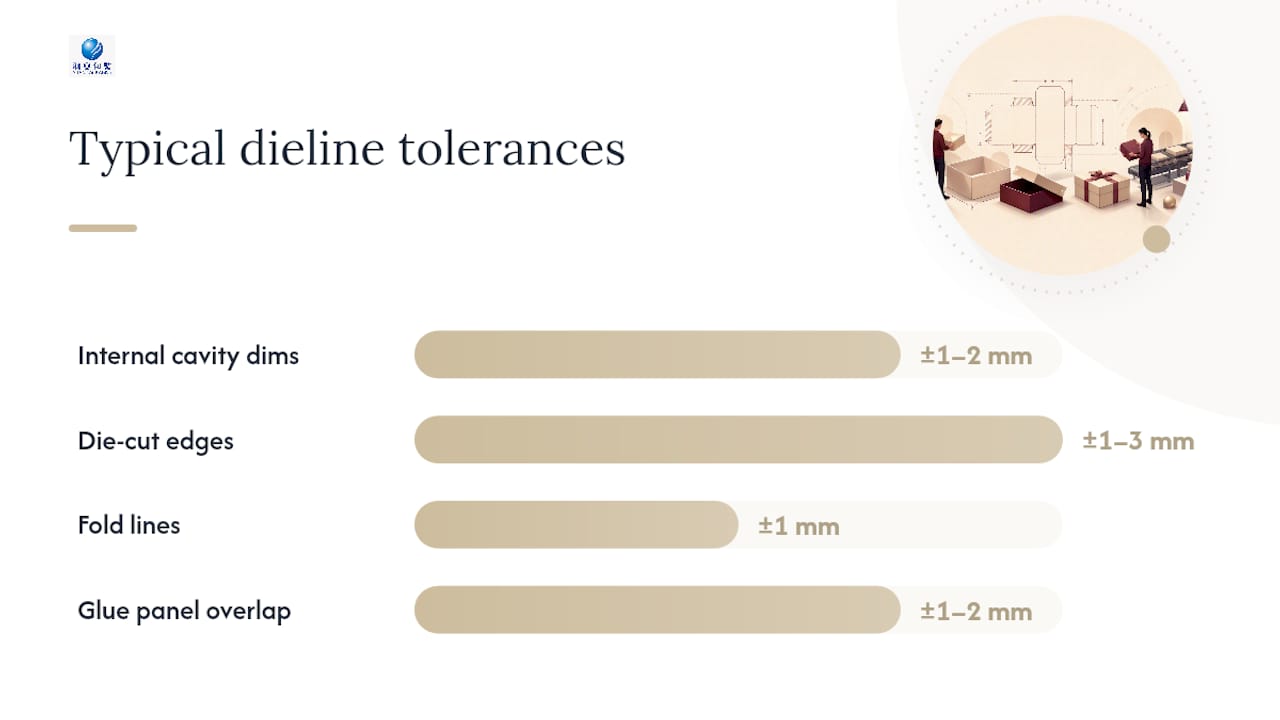
A dieline is the contract between your design intent and the factory floor. It needs internal dimensions, bleed, glue panel locations, folding lines, and die-cut allowances clearly marked, along with a file format note (vector files, with bleed and fold lines specified separately from artwork). Miss any of these and a supplier is left interpreting your intent, which is exactly where sizing errors start.
Tolerances exist because board and wrap materials respond to manufacturing pressure, not because factories are imprecise. A tolerance window of plus or minus 1 to 3 millimeters is standard on rigid boxes; that window can widen on very large formats or on features thinner than a few millimeters, where material behavior gets less predictable at scale.
| Dieline element | What it defines | Typical tolerance |
|---|---|---|
| Internal cavity dims | Product and insert fit | ±1 to 2 mm |
| Die-cut edges | Panel shape accuracy | ±1 to 3 mm |
| Fold lines | Corner squareness | ±1 mm |
| Glue panel overlap | Structural bond strength | ±1 to 2 mm |
Wrap tension during assembly, edge finishing quality, and glue application all shift a box’s final assembled size slightly from the dieline’s theoretical numbers. Manufacturing involves die-cutting the greyboard core, folding and gluing it, then wrapping printed paper around the structure separately, and each stage introduces its own small variance. Quality control checks corner tightness, wrap alignment, and overall squareness against your approved sample, not against the dieline file alone.
How Do Order Quantity and Sampling Affect Your Timeline?
Sizing decisions and production scheduling are tied together more than most procurement teams expect.
- *Check minimums early.** Many manufacturers set minimums around 100 units for custom rigid packaging, and tooling costs get spread across your run, so quantity directly affects unit price.
- *Budget for at least one sample round.** Pre-production samples confirm fit, wrap quality, and finish accuracy, and reorders move faster once the structural engineering is already approved.
- *Plan sample lead time separately from production lead time.** Samples typically take longer per unit than full runs because they’re built manually rather than on tooled lines. Build this into your launch calendar with margin, not as an afterthought.
- *Consider standardizing sizes across your line.** Brands that narrow down to two or three core box sizes for seasonal collections simplify sourcing and reduce SKU-level inventory risk.
What QC Checks Prevent Sizing Rework?
Before signing off on any sample, check core assembly strength, corner squareness, wrap color match and tension, finish registration and depth, and actual fit with the insert installed. These five checkpoints catch the failures that cause reprints.
The most common sizing mistakes are avoidable: sizing the box to the bare product without accounting for inserts or wrapping, under-specifying board weight for the product’s actual weight and route, ignoring how finish thickness eats into clearance, and skipping tolerance specs entirely. Buyers who size only to the product end up with boxes that fit on a bench but fail once an insert and wrapped product are combined.
- Require formal sample sign-off before production release, in writing
- Put acceptance criteria directly in the purchase order, not in a side email
- Spell out tolerances numerically rather than describing them as “tight” or “standard”
**Pro Tip:** _Ask your supplier to hold the approved sample as the physical reference for the run. A photo isn’t enough. Corner tension and wrap color read differently in person than on a screen._
What Are Standard Gift Box Sizes by Product Category?
There’s no single universal size chart in rigid packaging, because internal cavities are built around the product, not the reverse. Still, certain categories cluster around recognizable benchmarks that make useful starting points for a first RFQ conversation.
Cosmetics sets built around a jar and one or two accessories typically land in a compact footprint, often under 200 millimeters on the longest side, with a shallow height unless a pump or applicator adds vertical space. Fragrance and spirits boxes built for a single standing bottle tend to run taller and narrower, with internal height driven by bottle and cap height plus standing clearance rather than width. Multi-piece gift sets, common in skincare and spirits gifting bundles, run larger overall and depend heavily on insert design to keep each component from shifting against its neighbors.
Jewelry and small accessory boxes stay small and shallow, often under 100 millimeters on any side, where a few millimeters of extra clearance is the difference between a snug, premium feel and a piece that rattles.
None of these are fixed rules. They’re reference points. A boutique fragrance house launching a heavier flacon, or a spirits brand packaging a set with a glass and a bottle together, will land outside these ranges entirely. That’s exactly why the RFQ specs at the top of this guide matter more than any generic size chart: the box gets built to your product’s actual measurements, not to a category average.
How Does Box Size Affect Shipping Costs?
Packaging dimensions drive freight cost through two separate mechanisms, and both punish oversized boxes.
Dimensional weight pricing, used across most parcel carriers, charges based on a box’s cubic volume when that volume exceeds a carrier’s weight-to-size ratio. A lightweight but oversized gift box can cost more to ship than a smaller, denser one, even at identical actual weight. Excess clearance inside the box, or an outer carton sized loosely around the rigid box itself, inflates that cubic volume for no protective benefit.
The second mechanism is pallet and container efficiency during bulk transit to your warehouse or fulfillment center. A box with 10 millimeters of unnecessary clearance on each dimension doesn’t sound like much per unit, but multiplied across a pallet of several hundred units, it can mean measurably fewer boxes per shipment and a real increase in per-unit freight cost. Right-sizing internal clearance to the product, rather than padding it “to be safe,” pays off twice: once in reduced material use and again in shipping efficiency.
This is one more reason board thickness decisions and clearance decisions can’t be made in isolation. A slightly heavier board that protects the product adequately at tighter clearance often ships cheaper overall than a lighter board padded with extra internal room to compensate for structural doubt.
How Do You Size Boxes for Irregular or Delicate Products?
Standard dieline math assumes a roughly rectangular product. Curved decanters, layered gift sets, and delicate glass items need a different approach.
Start with a physical or digital mock-up rather than tape-measure estimates. A foam block cut to the product’s actual silhouette, or a 3D scan for higher-value or higher-volume runs, gives your supplier a real geometry to engineer the dieline around instead of a set of approximate numbers that assume straight edges.
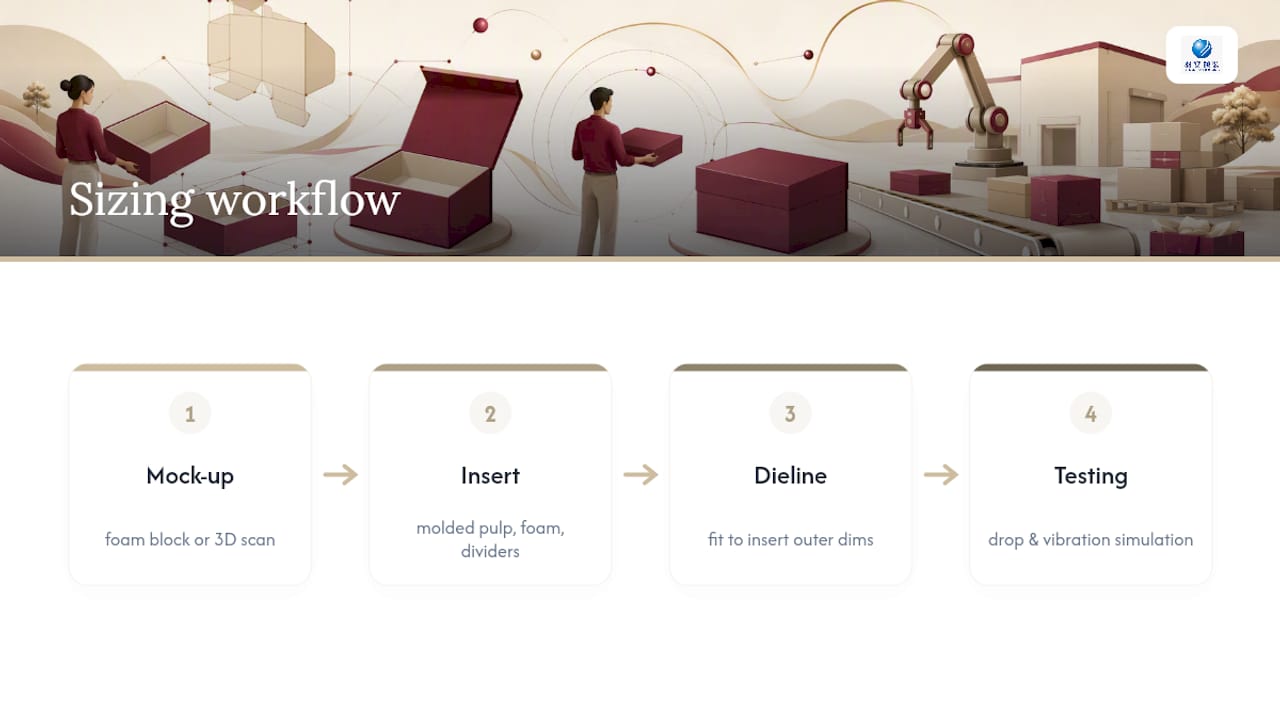
For delicate items, the insert matters as much as the outer box. Molded pulp trays, die-cut foam, or cardboard dividers custom-fit to the product’s actual contours do the real protective work, and the rigid box’s internal dimensions need to be built around the insert’s outer dimensions, not the naked product. This is where the clearance ranges from earlier in this guide (5 to 15 millimeters for multi-piece sets) become a starting estimate rather than a final answer. A curved or asymmetric product may need more clearance on one side than another, which a standard rectangular dieline can’t express without modification.
Test any irregular-fit design with a transit simulation if the run is large enough to justify it: a drop test or vibration test on the sample catches shifting and impact problems before they show up as damaged product complaints after launch.
Who Provides What at RFQ: Buyer vs. Supplier Responsibilities
Sizing errors almost always trace back to a gap in who was supposed to supply which detail. Splitting responsibilities clearly at the RFQ stage closes that gap before production starts.
**The buyer supplies:**
- Internal product dimensions, with orientation and insert allowances already factored in
- Target order quantity, including any near-term reorder expectations
- Preferred materials and finish direction (wrap type, color system, foil or emboss intent)
- Any brand-specific structural requirements (magnetic closure, ribbon pull, custom insert)
**The supplier supplies:**
- Recommended board thickness based on product weight and category
- A production-ready dieline reflecting the buyer’s dimensions and chosen construction
- Tolerance specifications appropriate to the design’s complexity
- A pre-production sample for fit, wrap, and finish sign-off before the run is released
Where this breaks down most often is finish thickness. Buyers rarely think to specify foil or emboss depth, and suppliers don’t always volunteer how much that finish will eat into clearance unless asked directly. Put finish specification on your side of the list, not the supplier’s, and confirm it before dielines are finalized rather than after a sample arrives tighter than expected.
Why Following the RFQ Checklist Actually Reduces Launch Risk
Twenty five years of building rigid boxes for beauty, spirits, and lifestyle brands teaches you where sizing projects actually go wrong, and it’s rarely the dieline math. It’s the gap between what a brand team assumes a supplier knows and what actually gets written down. Industry experience shows that projects that move from RFQ to shipped product with a single sample round are, without exception, the ones where internal dimensions, board thickness, and construction style were specified in writing before the first dieline draft.
The checklist in this guide isn’t procedural box checking. It’s a filter against the two failure modes that cause reprints: sizing to the bare product instead of the wrapped, inserted product, and treating board thickness as a cosmetic choice instead of a transit-risk calculation. Brands that supply complete specs upfront typically need one sample approval round instead of three. That difference alone can save weeks on a launch calendar, and weeks matter more in gifting seasons than almost any other packaging category.
_— Anthony_
Ready to Turn These Specs Into a Sample?
Reading a sizing guide only gets you halfway. The next step is putting your actual product dimensions, board preference, and construction choice in front of a manufacturer who can turn them into a dieline and a physical sample, not just a quote on paper.

Some custom rigid gift box manufacturers for beauty, spirits, and lifestyle brands include pre-production sampling in projects so fit and finish can be confirmed before full production runs. Certain suppliers also offer global logistics support to scale specs for international distribution. If you’re weighing board thickness, clearance, or construction style for an upcoming collection, start with the custom rigid gift box product page and request a quote with the RFQ fields from this guide already filled in. If your line includes magnetic closures specifically, the magnetic closure box page covers the added tolerance considerations that structure requires. Either way, the fastest path to an accurate quote is sending your internal dimensions and preferred board weight first, then requesting a sample before committing to volume.
Sources
- Custom Rigid Boxes in 2026: Materials, Construction & Buyer’s Guide - oTechWorld
- Pick the Right 2–3 Sizes: Bag Size Chart for Packaging Buyers – Gatherpackaging
- How to build an eco-friendly custom packaging workflow – Gatherpackaging
FAQ
What Is the Standard Board Thickness for Rigid Gift Boxes?
Greyboard cores typically run 2 to 4 millimeters thick, with 2 to 3 millimeters suited to light goods and 3 to 4 millimeters recommended for heavier items like spirits bottles or multi-piece sets.
How Much Clearance Should I Add Inside a Gift Box?
Clearance depends on the product: 1 to 3 millimeters for jewelry, 2 to 5 millimeters for cosmetics, and 5 to 15 millimeters for multi-piece gift sets, measured beyond the product and any insert.
What Dimensional Tolerance Should I Expect From a Manufacturer?
Most rigid box dielines carry a tolerance window of plus or minus 1 to 3 millimeters, with wider tolerances possible on very large formats or thin structural features.
How Many Sample Rounds Does a Custom Rigid Box Typically Need?
One sample round is common when internal dimensions, board thickness, and construction style are fully specified at RFQ; incomplete specs often push projects into two or three rounds.
Does Yuanpackaging Offer Pre-Production Samples for Rigid Gift Boxes?
Yes, Yuanpackaging provides pre-production samples so buyers can verify fit, wrap, and finish before committing to a full custom rigid box production run.