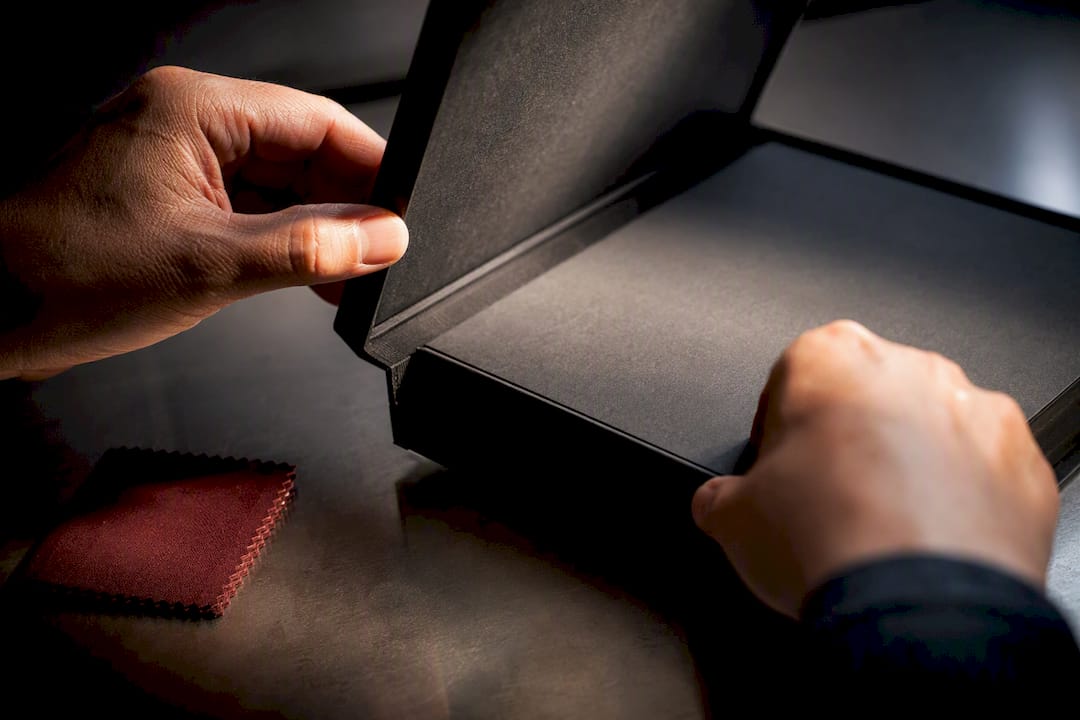
A hinged lid box is a container whose lid stays permanently attached to its base through an integral, cloth, or mechanical hinge, so it opens on one axis instead of lifting fully away. Choose an off-the-shelf plastic hinged bin for warehouse storage and small-parts organization, and choose a custom rigid hinged box when the unboxing moment itself needs to sell your brand. Everything after this comes down to matching the hinge type, material, and finish to that job.
**TL;DR:** Custom hinged rigid boxes offer consistent quality, exact branding, and finish control at high volumes, unlike off-the-shelf plastic bins. The most durable hinges for retail and gift boxes are cloth or fabric hinges, with integral plastic hinges being cheaper but less long-lasting. Accurate product measurements, appropriate clearance, and a pre-production sample are essential to avoid fitting issues and costly revisions. Finishing options like foil stamping, spot UV, and embossing elevate the unboxing experience and can be tailored to match marketing goals. Choosing a vendor requires clear questions about minimum order quantities, tolerances, lead times, and certifications, with reputation checked on review platforms.
Table of Contents
- What Is a Hinged Lid Box, and Which Variant Fits?
- What Materials and Finishes Work Best for a Hinged Lid Box?
- How Are Hinged Lid Boxes Constructed and Hinged?
- How Do You Size and Specify a Hinged Lid Box Correctly?
- What Customization Options Improve the Unboxing Experience?
- How Do You Choose the Right Hinged Lid Box and Vendor?
- Why Work With a Custom Hinged Rigid Box Manufacturer?
- What I’ve Learned Watching Hinged Box Projects Go Right and Wrong
- How Yuanpackaging Turns a Hinged Lid Box Brief Into Production
- Sources
- FAQ
What Is a Hinged Lid Box, and Which Variant Fits?
Not every hinged lid box works the same way, and the differences matter more than most buyers expect before their first order.
The **one-piece integral hinge** box is molded or die-cut so the lid and base share a single continuous piece of material, connected by a thin, flexible section that flexes open and closed like a joint. You see this constantly in plastic storage. The Sterilite 30-qt HingeLID storage box uses exactly this approach, with a lid that stays attached and open for easy access while latches keep it secured during transport.
A **two-piece lid-and-base** design, by contrast, uses a separate lid that slips over or nests into a distinct base tray, with a cloth or paper hinge joining them at the back. This is the classic rigid gift box format. The FEFCO 0300 lid-and-base template is the industry-standard dieline for this style, giving a snug, reusable fit that holds up to repeated opening without loosening.
**Book-style flip-top boxes** open like a hardcover book, hinged along one long edge with the lid folding back a full 180 degrees. They’re popular for spirits, cosmetics, and tech accessories because the reveal feels deliberate. **Sliding lid boxes**, meanwhile, skip the hinge mechanism entirely in favor of a channel or groove that lets the lid slide off along a track, a construction more common in wooden and handcrafted boxes than mass production.
- *Integral hinge (plastic):** Best for warehouse storage, small parts, and stackable bins; weak on brand presentation.
- *Cloth/paper hinge (two-piece rigid):** Best for retail and gift presentation; adds unit cost but delivers a premium feel.
- *Book-style flip-top:** Best for a dramatic reveal on spirits, beauty, and electronics; needs careful hinge reinforcement for repeat use.
- *Sliding lid:** Best for artisanal or wooden boxes; slower to produce and less common at scale.
What Materials and Finishes Work Best for a Hinged Lid Box?
Material choice determines whether your box protects contents, survives shipping, or simply looks expensive on a shelf, and it’s rarely all three at once.
**Rigid paperboard** (also called setup boxes) is the standard for premium presentation. It’s thick, dense chipboard wrapped in printed paper or fabric, and it holds sharp corners and crisp edges that folding carton can’t match. **Folding carton** is thinner and scores/folds flat for shipping, which cuts freight costs dramatically but sacrifices some of that substantial, luxury hand feel. **Corrugated board** trades polish for strength, useful when the hinged lid box also has to survive a parcel network. **Polypropylene**, the material behind products like the Flex-A-Tops hinged lid containers, resists moisture and air intrusion, which is why lab and small-parts storage leans on it heavily. **Woven rush and natural fiber** boxes, sold by retailers as decorative storage pieces, skip printing entirely in favor of texture.
Board weight (measured in points or grams per square meter) is the number that separates a box that survives a shipping run from one that dents on the first drop. A light 1,200-gsm board might suit a lightweight cosmetic sample; a 2,000-gsm-plus board with corner reinforcement is closer to what spirits and heavier gift sets need to stack safely on a shelf.
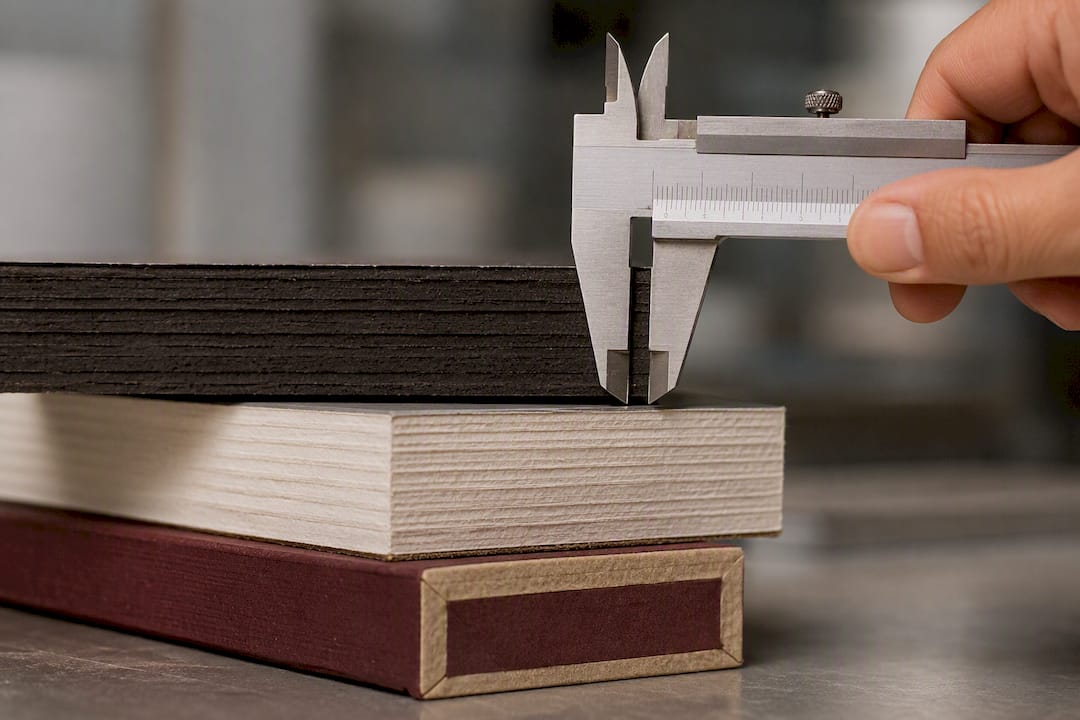
**Pro Tip:** _Ask your manufacturer for the exact gsm rating and a stacking test result, not just a description like “sturdy” or “heavy duty.” Those words mean nothing on a spec sheet._
Finishing is where the box stops being a container and starts being marketing:
- *Soft-touch or matte lamination** gives a velvet-like hand feel that signals restraint and quality.
- *Foil stamping** adds metallic accents to logos and typography, catching light without adding printed ink.
- *Spot UV** creates a glossy raised contrast against a matte background, often used to highlight a single design element.
- *Embossing/debossing** physically shapes the board surface for a tactile, dimensional logo or pattern.
Each of these adds cost and a production step, so the right combination depends on whether the box needs to survive a warehouse or survive an Instagram unboxing video.
How Are Hinged Lid Boxes Constructed and Hinged?
The hinge mechanism is the single biggest factor in how long your box lasts and how much it costs per unit, yet it’s the detail most buyers skip past when comparing quotes.
An **integral or living hinge** is molded directly into a single piece of plastic or scored into a single sheet of board, so there’s no separate hardware or adhesive joint to fail. It’s cheap and fast to produce but wears out faster under heavy repeated use, since the flex point is thinner material by design.
A **cloth hinge** uses a strip of fabric or specialty paper glued across the seam between lid and base on a two-piece rigid box. This is the standard for premium retail and gift boxes because it’s nearly invisible once wrapped and it holds up to hundreds of open/close cycles without cracking, unlike a bare paper fold.
**Glued tab hinges** are a lower-cost variant, where a paper or board tab is folded and adhered without fabric reinforcement. They work fine for lighter lids but tend to fatigue faster.
**Metal or architectural hinges**, small pin-and-barrel hardware set into wood or heavy board, show up in premium jewelry boxes and archival cases. They’re the most durable option and the most expensive to source and install, since each hinge has to be precisely seated and often finished matching the box hardware.
- Integral hinge: lowest cost, fastest production, shortest lifespan under heavy use.
- Cloth hinge: mid cost, high durability, standard for rigid gift and retail boxes.
- Glued tab: low cost, moderate durability, common on lighter folding cartons.
- Metal/architectural: highest cost, longest lifespan, reserved for premium or archival pieces.
Assembly method also swings unit economics. Manual assembly, where a worker wraps board and applies hinges by hand, allows more design complexity and lower minimum order quantities but costs more per unit. Automated assembly lowers per-unit cost at volume but usually locks you into simpler geometries and higher minimums. If your run is under a few thousand units, expect hand assembly regardless of what a quote implies.
**Pro Tip:** _If your product ships direct-to-consumer and gets opened repeatedly (a jewelry box, a subscription reveal box), specify a reinforced cloth hinge upfront. Retrofitting hinge strength after a batch of customer complaints costs far more than adding it at the sampling stage._
How Do You Size and Specify a Hinged Lid Box Correctly?
Getting the fit wrong is the most common and most expensive mistake in hinged box ordering, and it almost always traces back to skipping one of these steps.
- *Measure your product at its widest, tallest, and deepest points**, including any packaging insert, tag, or accessory that ships inside. Measure the actual production sample, not a prototype or renderings.
- *Add protective clearance** around each dimension. A rigid two-piece box generally needs a few millimeters of clearance per side for the product to seat without rattling, plus extra depth if there’s an insert or cushioning layer.
- *Confirm lid-to-base clearance separately from product clearance.** The FEFCO 0300 lid-and-base template is a widely used starting dieline precisely because it’s engineered for a snug, reusable fit rather than a loose slip cover, and starting from a proven template avoids guesswork.
- *Request a dieline or CAD file before committing to print.** A printed dieline shows every fold, hinge point, and panel dimension flattened, which is the only reliable way to check that your artwork lands where you expect it.
- *Order a physical sample or prototype before full production.** No amount of digital review catches a fit problem the way holding an actual box does; a hinge that looks fine on screen can bind or gap once it’s real board in your hands.
If you’re specifying a wooden or handcrafted sliding lid rather than a hinged one, expect the tolerances to be even tighter. FineWoodworking’s guide to sliding lid boxes notes that a smooth sliding action takes multiple milling passes and careful stock preparation, since wood movement makes a snug fit harder to hold consistently than board or plastic.
What Customization Options Improve the Unboxing Experience?
The line between a hinged lid box that protects a product and one that sells it comes down to a handful of add-ons layered onto the base structure.
Surface treatments do the heavy visual lifting: full-color offset or digital printing sets the brand story, foil stamping and spot UV pick out logos and key details, and embossing adds a dimensional touch you can feel before you even open the lid. Structural add-ons go further. A **window**, a die-cut opening backed with clear film, lets the product show through without opening the box at all, which retail buyers often favor for impulse purchases. **Inserts**, whether foam, cardboard, or fabric-wrapped board, hold each item in a fixed position and turn a plain box into a presentation tray the moment the lid lifts.
Interior materials matter as much as the exterior:
- *EVA foam inserts** cushion fragile or oddly shaped items and can be die-cut to an exact product silhouette.
- *Cardboard partitions** organize multi-item sets (a spirits gift set, a skincare bundle) without adding much cost.
- *Soft-touch fabric linings** upgrade jewelry, watch, or specialty gift boxes where the interior is part of the reveal, not just protection.
Sustainability is no longer a side conversation. Recycled board, FSC-certified paperboard, and recyclable laminates now compete directly with virgin materials on cost and performance, though soft-touch and certain foil finishes can complicate recyclability, something worth asking your manufacturer about directly rather than assuming. A shift toward sustainable packaging is reshaping what “premium” means for a lot of brand buyers, and a hinged lid box built on FSC-certified board can carry that story on the shelf as effectively as a foil logo does.
How Do You Choose the Right Hinged Lid Box and Vendor?
The right hinged lid box depends less on what looks best in a catalog and more on the job it has to do. Storage calls for stackability and moisture resistance. Presentation calls for hand feel and print fidelity. Archival use calls for acid-free board and hinge stability over years, not months. Shipping direct-to-consumer calls for a structure that survives a parcel network without a secondary outer box.
Once you know the job, the vendor conversation should cover a specific list of questions, not a general “can you make this” email:
- What is the minimum order quantity, and does it change with added finishes like foil or embossing?
- What are realistic lead times for sampling versus full production?
- Is there a sample or prototype policy, and what does it cost?
- What print specifications and color matching standards (Pantone, CMYK) do they support?
- What fit tolerances do they guarantee on lid-to-base clearance?
- What certifications (FSC, ISO) can they document, not just claim?
Independent review platforms like Trustpilot are worth checking before you commit budget to an unfamiliar vendor, since supplier reputation issues (missed timelines, inconsistent quality) tend to surface there before they show up in a sales call.
| Buying priority | What to specify | Vendor question to ask |
|---|---|---|
| Storage/utility | Stackable, moisture-resistant plastic or coated board | What’s the recessed lid design for stacking? |
| Retail presentation | Rigid board, cloth hinge, print/foil finish | What Pantone matching do you guarantee? |
| Archival/long-term | Acid-free board, reinforced hinge | What’s the hinge’s tested open/close cycle life? |
| Direct-to-consumer shipping | Reinforced corners, snug FEFCO-style fit | Does the box need an outer shipping carton? |
Watch for vague quotes that skip tolerance details, “flat rate” pricing that doesn’t shift with finish complexity, and any vendor unwilling to produce a physical sample before a large production commitment.
Why Work With a Custom Hinged Rigid Box Manufacturer?
A custom hinged rigid box does something an off-the-shelf bin structurally cannot: it repeats your exact brand experience, unit after unit, at whatever volume your product line needs. That consistency, matched Pantone colors, identical hinge tension, the same foil placement on box ten thousand as box one, is what makes a hinged lid box feel like part of the product rather than an afterthought around it.
Yuanpackaging has spent many years producing exactly this category of packaging, delivering millions of units to thousands of brands across beauty, spirits, and lifestyle categories. That scale matters for two practical reasons. First, it means sampling and prototyping processes are mature. Ordering a custom lid-and-base box or a book-style hinged box comes with a structured path from dieline to physical sample before committing to a full run. Second, it means finishing capability, foil stamping, embossing, spot UV, and specialty hardware like magnetic closures, is available at both small-batch and high-volume scale, not locked to one or the other.
Sustainability sourcing is built into that same production infrastructure rather than bolted on as a separate line item, which matters for brands trying to make FSC-certified or recyclable claims that actually hold up under scrutiny.
What I’ve Learned Watching Hinged Box Projects Go Right and Wrong
The single biggest predictor of a smooth hinged lid box order isn’t the design, it’s how much sampling time gets built into the schedule. Brands that budget for two or three rounds of physical prototypes almost always end up happier with the final hinge tension and fit than brands that approve a digital render and go straight to production. Digital proofs can’t show you how a cloth hinge feels after the fiftieth open, or whether a lid seats flush against a base under real board tolerances.
The most common specification mistake is treating clearance as an afterthought instead of a decision. Buyers measure the product, forget the insert, and end up with a lid that won’t close flush. On lead times, plan backward from your launch date and assume sampling alone eats two to three weeks before production even starts, longer if a finish like foil stamping needs its own approval round.
_— Anthony_
How Yuanpackaging Turns a Hinged Lid Box Brief Into Production
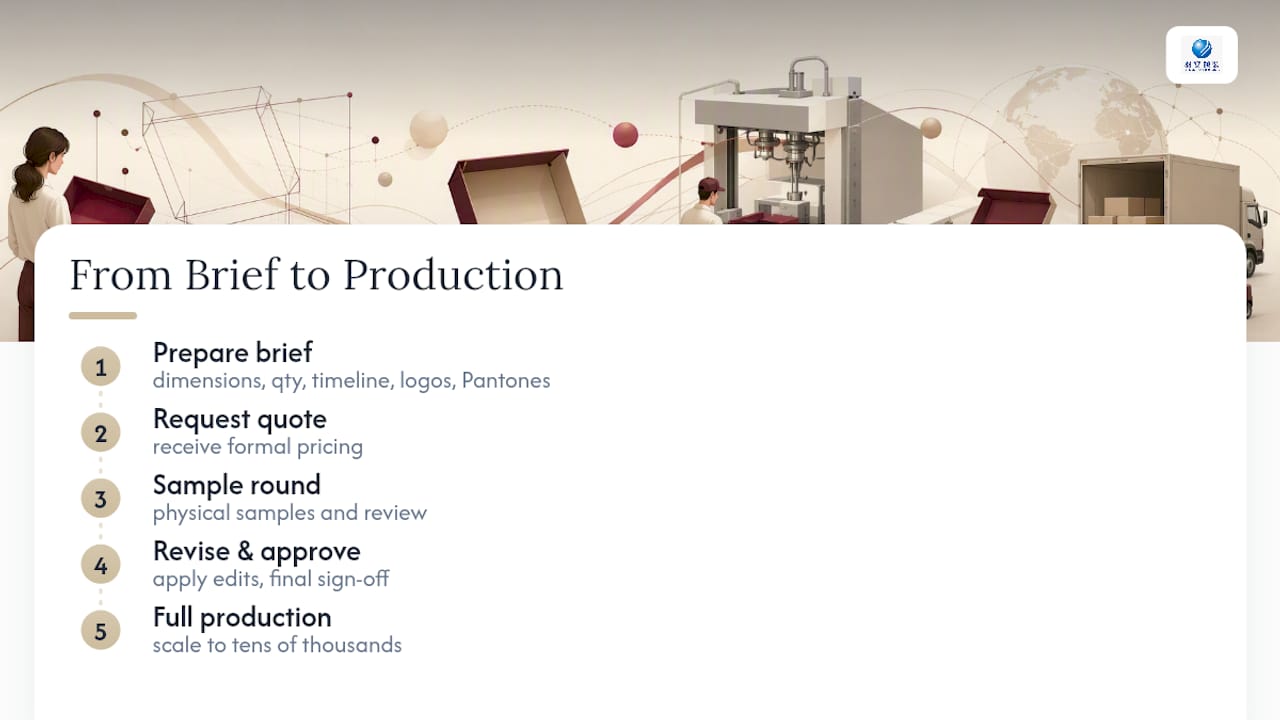
Yuanpackaging is the direct route to a hinged lid box that’s actually built around your product, not adapted from a stock mold. Where a catalog bin forces you to fit your brand into whatever size and finish already exists, custom manufacturing starts from your dimensions, your Pantone colors, and your hinge preference, then scales that exact spec from a handful of samples to tens of thousands of units without the design drifting between batches.
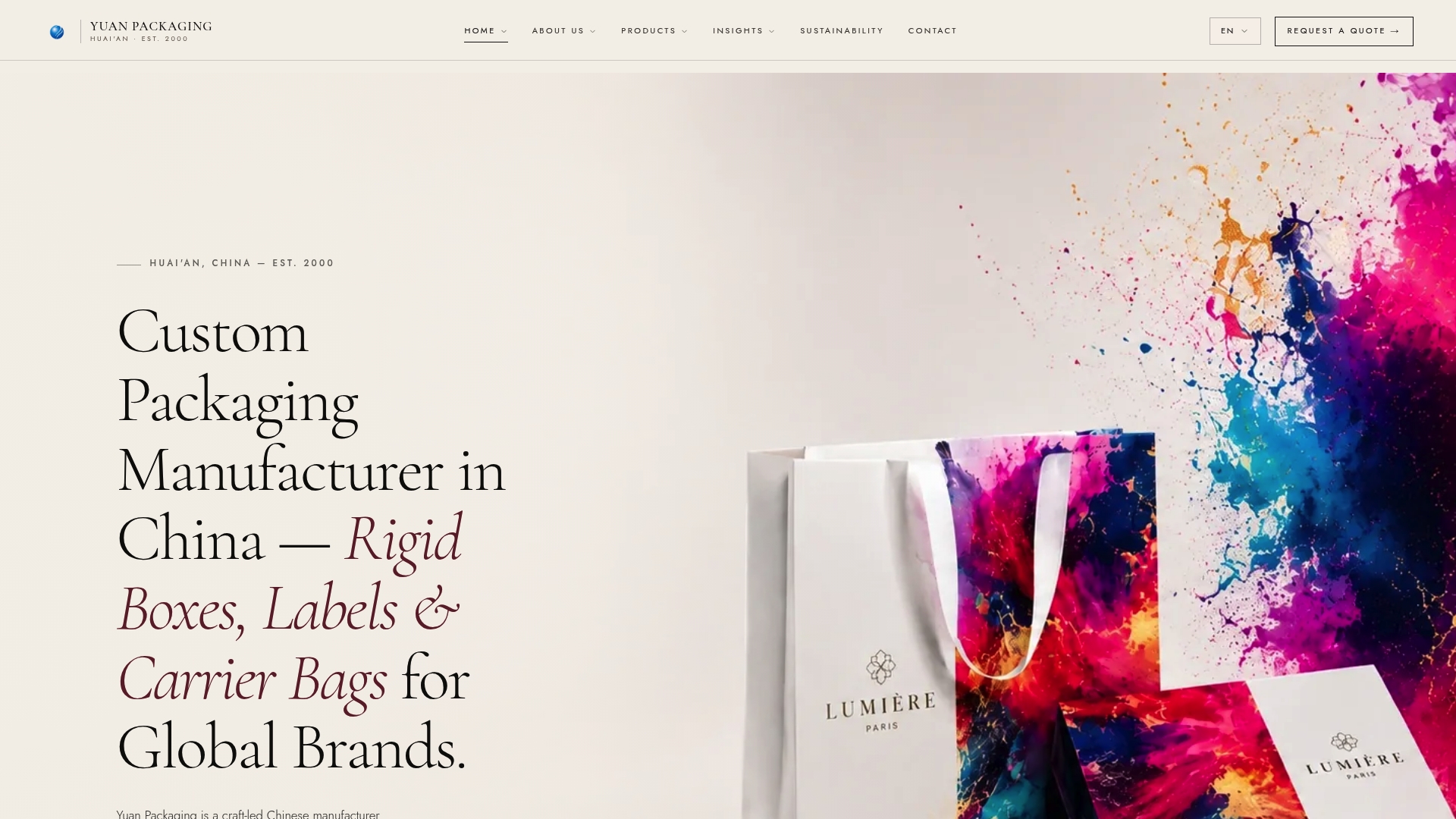
The process starts with a brief: your product dimensions, target quantity, preferred material (rigid board, folding carton, or specialty substrate), and any finishing you have in mind, foil, embossing, spot UV, or a magnetic closure alternative to a standard hinge. From there, expect a quote, a physical sample round, and revisions before full production begins. Yuanpackaging’s rigid box product line covers everything from two-piece lid-and-base structures to book-style flip-tops, and design support is available from the first dieline through final approval.
Before reaching out, gather your product measurements, target order volume, rough timeline, and any brand assets (logo files, Pantone references) so the first quote comes back accurate instead of provisional. Request a sample or quote to see what a custom hinged box built for your exact product looks and feels like before you commit to a production run.
Sources
If you’re moving from research to a real order, three resources are worth bookmarking. The FEFCO 0300 lid-and-base dieline gives you a production-tested starting template for two-piece rigid boxes, useful for checking your own measurements against a proven fit. The Sterilite HingeLID product page shows how dimensions and stacking features are typically documented for plastic storage bins, a useful spec-sheet model even if you’re ordering rigid board instead. For handling and storage guidance once your boxes are produced, this rigid box storage and handling overview covers conditions that protect finished inventory before it ships.
- Flex-A-Tops Small to Med Hinged Lid Plastic Box Containers
- Make a Sleek Box with a Sliding Lid - FineWoodworking
FAQ
What Is a Hinged Lid Container?
A hinged lid container is any box or bin whose lid stays permanently attached to its base through an integral, cloth, or mechanical hinge, allowing it to open on one axis rather than lifting away completely.
What Is the Best Type of Hinge for a Box Lid?
It depends on use: integral plastic hinges suit utility storage and low cost, while cloth hinges are the standard for premium rigid boxes because they withstand hundreds of open and close cycles without cracking.
What Is a Hinged Lid?
A hinged lid is a lid connected to its box base by a flexible joint, whether molded plastic, glued fabric, or a mechanical pin hinge, so it swings open instead of detaching entirely.
What Is a Lidded Box Used For?
Lidded and hinged lid boxes serve storage, shipping protection, archival preservation, and retail or gift presentation, with the right choice depending on whether utility, protection, or brand experience matters most. For presentation use cases specifically, a custom rigid hinged box from a manufacturer like Yuanpackaging typically outperforms off-the-shelf options on finish quality and brand consistency.