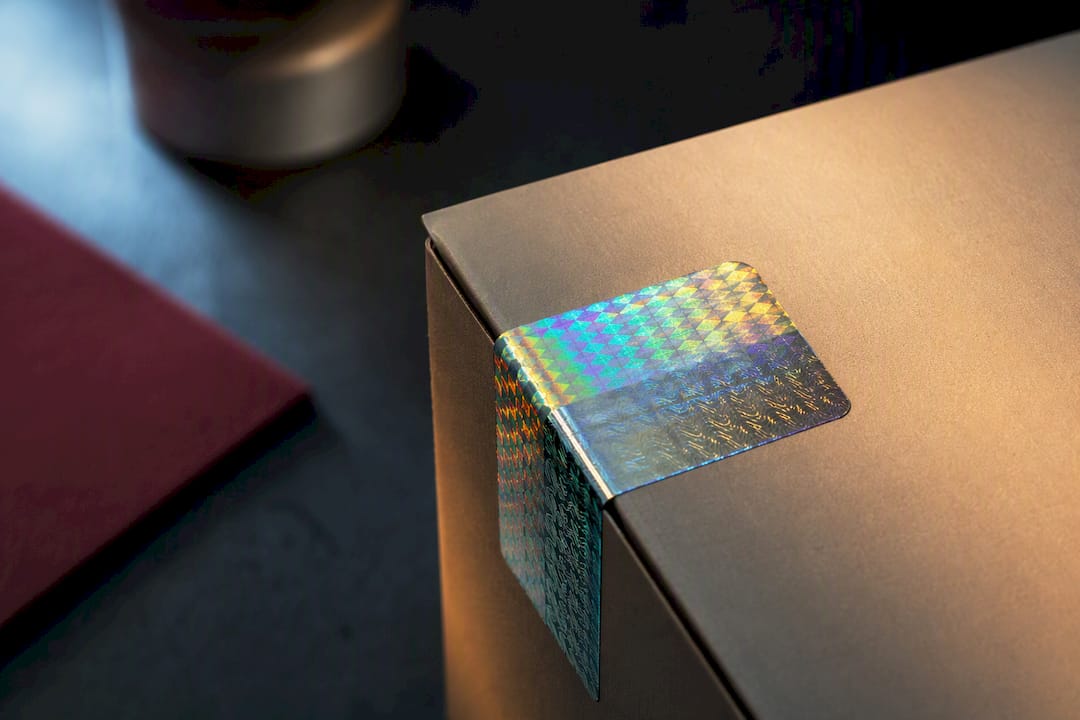
Use a custom, tamper-evident hologram security label with a unique serialized ID, and optional QR verification, as your visible authentication layer. Then request a sample pack and the supplier’s technical spec sheet before you approve anything. Hologram labels work best as one layer in a broader brand-protection system, not a standalone fix, so treat that sample request as the start of a real specification process rather than a formality.
**TL;DR:** Custom hologram security labels with serialized IDs and QR verification provide enhanced traceability and reduce the risk of counterfeiting compared to stock options. The master hologram’s complexity and custody controls are the most critical security factors, making secure origination a non-negotiable step. Durability depends on proper material matching, overprint methods, and adhesive choice; testing on actual substrates before full production is essential. Price and lead time vary significantly based on customization, security feature complexity, order volume, and digital verification infrastructure. A layered anti-counterfeit system combining visible, covert, serialization, and digital verification features is necessary to deter both casual and sophisticated counterfeiters.
Yuanpackaging
Explore Yuan Packaging
Table of Contents
- What Are Hologram Security Labels and How Do They Work?
- Which Hologram Types and Security Features Should You Specify?
- Design Choices That Affect Durability and Legibility
- What Drives the Price, MOQ, and Lead Time for Hologram Labels?
- How Do You Build a Layered Anti-Counterfeit Strategy Around Holograms?
- Vendor Selection Checklist for Procurement Teams
- How Do You Write a Hologram Label Spec Suppliers Can Actually Quote?
- What Does the Procurement Process Look Like From Selection to Delivery?
- What Do Hologram Security Labels Actually Cost?
- How Long Does the Full Rollout Actually Take?
- Yuan Packaging’s Experience and Practical Tips for Buyers
- Request Samples and Technical Specs From Yuan Packaging
- Sources
- FAQ
What Are Hologram Security Labels and How Do They Work?
Hologram security labels rely on diffractive optics: microscopic patterns etched into a master hologram bend light at different angles, producing the shifting colors and depth effects you see when you tilt the label. That master is the entire barrier to counterfeiting. Copying it requires specialized origination equipment, precise laser engraving, and access most counterfeit operations simply don’t have. Industry guidance from the International Hologram Manufacturers Association makes this point directly: a hologram’s real security value depends less on how it looks and more on how difficult that master is to replicate, and how tightly the manufacturer controls access to it during production.
That’s why the strongest programs separate features into two categories. Visible effects, like 2D/3D imagery, color shift, and kinetic “flip flop” motion, let a consumer or retail clerk check authenticity in a few seconds with no equipment. Covert features, like microtext, laser-readable marks, or nano-scale structures, exist for forensic teams and investigators, not shoppers, and counterfeiters rarely know they’re even present. The most advanced tier, sometimes called Nano Optical Imaging, uses submicron 3D structures resolved above 600,000 dpi, a resolution ordinary printing and imaging equipment can’t approach.
None of this makes a hologram bulletproof on its own. A determined counterfeiter can still source generic stock holograms that look convincing at a glance. That’s the argument for treating the label as one layer among several, not the whole strategy.
Which Hologram Types and Security Features Should You Specify?
Your specification decisions here determine both your security level and your budget, so it helps to know exactly what you’re choosing between before you call a supplier.
**Format and construction:**
- *Stock holograms** carry generic, non-exclusive imagery available to any buyer. They deter casual copying but offer no brand-specific protection.
- *Custom holograms** use an origination created exclusively for your brand, tied to a master your supplier controls.
- *Transfer foil** is hot-stamped directly onto packaging or cartons, ideal for rigid boxes and folding cartons where a label edge would look out of place.
- *Laminated PET labels** apply as self-adhesive stickers, better suited to bottles, jars, and cosmetic packaging that need a stand-alone applied label.
- *Tamper-void adhesives** fracture or leave a visible pattern when removed, versus **permanent adhesives** that resist removal but don’t signal tampering.
**Security features worth requesting:**
- Microtext and micro-embossing, readable only under magnification
- 2D/3D imagery and kinetic flip-flop effects for at-a-glance visual checks
- Covert, laser-readable images invisible without specialized readers
- Serialization with unique numeric or alphanumeric IDs
- Integrated QR codes linked to a verification portal
Serialization and QR integration deserve particular attention. A hologram gives you a visual deterrent; a unique serialized ID turns each label into a trackable data point, which matters enormously once you’re chasing down where a counterfeit batch actually entered the supply chain.
Design Choices That Affect Durability and Legibility
Material and finishing decisions shape how a hologram performs on the shelf, not just how it looks in a mockup. Holographic PET stock behaves differently than transfer foil once it meets your actual substrate, and getting that match wrong shows up fast, either as poor adhesion on glass, cracking on flexible pouches, or a foil that won’t sit flat on textured rigid stock.
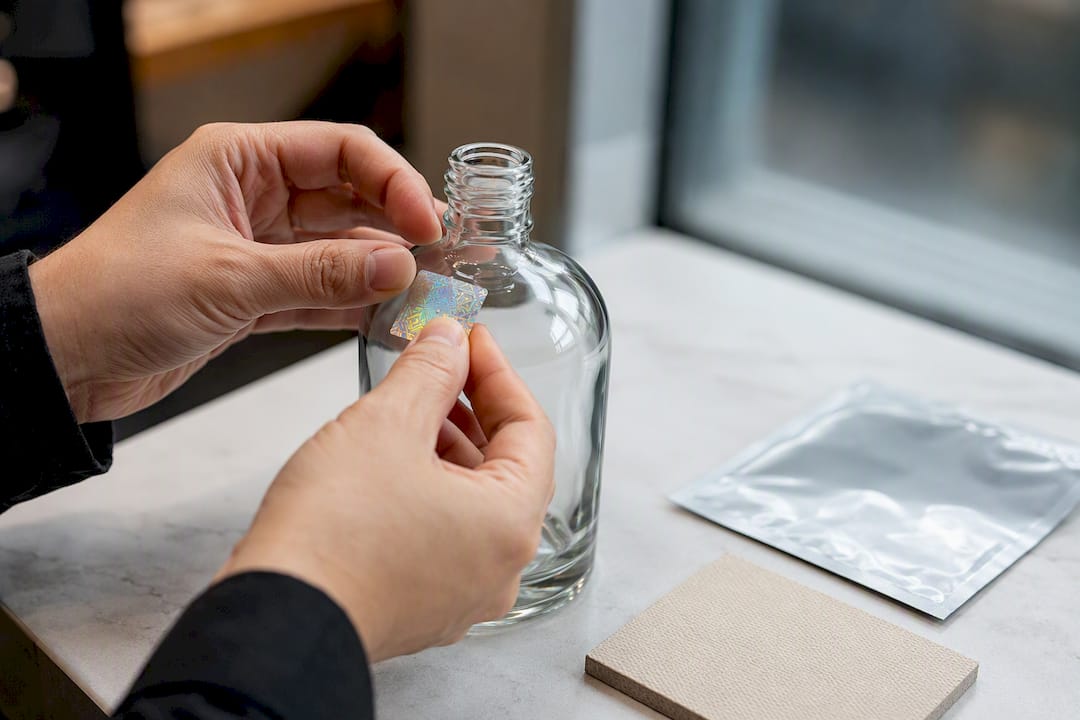
Overprinting is where a lot of brand teams get surprised. Printing directly onto a holographic surface without preparation often washes out the optical effect, since the ink sits on top of the diffraction pattern and dulls it. Printer guidance across the industry consistently recommends a white ink underprint or selective overprint, leaving key holographic zones untouched so the security effect stays visible while your logo or batch code stays legible.
A few practical guidelines matter here:
- Match adhesive strength to your tamper-evidence goal. A void adhesive that’s too aggressive can damage packaging on removal; too weak, and it won’t fracture reliably.
- Die-cut shape and placement should force the label across a seal, seam, or cap edge, not just sit decoratively on flat surface area.
- Avoid full-bleed overprint on the holographic zone if you need the shift effect to remain the primary consumer check.
**Pro Tip:** _Ask your supplier for a printed proof on your actual substrate, not a digital mockup. Holographic effects and overprint contrast look meaningfully different on a screen than on cosmetic glass, spirits paper labels, or matte carton stock._
What Drives the Price, MOQ, and Lead Time for Hologram Labels?
Procurement teams comparing quotes usually get surprised by how much the same-looking label can vary in cost and turnaround. Five factors explain most of that spread.
- *Customization level.** Stock imagery costs less than a custom origination built exclusively for your brand.
- *Security feature complexity.** Covert laser-readable images and nano-scale effects raise both tooling cost and per-unit price versus a basic 2D/3D shift.
- *Order volume.** Per-unit price drops sharply at higher volumes, but custom security features often carry higher minimums than standard label runs.
- *Lamination and finishing.** Tamper-void adhesive, specialty die-cuts, and overprint registration each add production steps.
- *Serialization and digital back-end.** A unique ID system with QR verification adds a data infrastructure cost on top of the physical label.
Stock holograms sometimes ship at relatively low minimums, while custom security holograms with a dedicated master origination typically carry meaningfully higher minimum order quantities, largely because the origination and tooling cost needs to be spread across a larger run to make sense.
Lead time follows a similar pattern. Sample creation is usually the fastest step; master hologram engraving and origination take considerably longer, and full production only starts once you’ve approved both the design and the security specification. Before you commit, request a sample pack, a technical spec sheet detailing every security feature, evidence of quality assurance testing, and a plain explanation of how the supplier controls custody of your master hologram.
How Do You Build a Layered Anti-Counterfeit Strategy Around Holograms?
A hologram alone catches the casual counterfeiter. A layered system catches the sophisticated one, and that distinction matters more than most brand teams initially assume when they’re budgeting for labels.
The model that works combines four elements: a visible deterrent (the hologram itself), a covert forensic feature only your team or investigators can check, a unique serialized ID on every unit, and a digital verification layer that ties a scan back to your own records. Security holograms with 4th-generation optical imaging push replication cost high enough that many counterfeiters simply move on to an easier target, but that only holds if the master itself stays secure.
That layered approach also serves three distinct users, each with a different job:
- *Consumers** get a quick visible check, or a QR scan against a verification portal, with no special equipment.
- *Distributors and retailers** use the same visible checks plus serialization lookups during receiving.
- *Forensic investigators** rely on covert features and lab-grade analysis when a counterfeit dispute needs to hold up legally.
The tradeoff worth naming honestly: more layers mean more cost and more data infrastructure to maintain, and a QR verification portal raises real questions about who owns the scan data and how it’s used. Decide those answers before launch, not after your first pilot batch.
Vendor Selection Checklist for Procurement Teams
Before you sign off on any hologram supplier, get four documents in hand: a technical spec sheet listing every security feature by name, evidence of how the master hologram is stored and accessed, quality assurance or testing records, and a written chain-of-custody procedure covering the entire production run.
Then ask direct questions. How does serialization work, and can the numbering scheme integrate with your existing inventory system? What does a pilot run look like, and can you order a small batch before committing to full volume? Is there a QR verification option, and who hosts that data?
Watch for these red flags:
- Vague or evasive answers about who has physical access to the master hologram
- Reluctance to provide a physical sample before you commit to an order
- MOQ or lead time numbers that shift depending on who you ask
- No clear quality assurance or testing documentation
**Pro Tip:** _If a supplier can’t clearly explain their master hologram custody procedure in one straightforward answer, that’s worth treating as disqualifying, not just a minor concern. Custody of the master is the single point of failure the IHMA points to most often._
How Do You Write a Hologram Label Spec Suppliers Can Actually Quote?
Vague briefs produce vague quotes. Suppliers can’t price security features they can’t see clearly defined, so your specification document needs to answer six questions in writing before it goes out.
State your substrate and application method first: bottle, carton, blister pack, or box, and whether you need a self-adhesive label or hot-stamped transfer foil. Name the specific security tier you want, using the vocabulary this article covers: 2D/3D visible effect, covert laser-readable feature, microtext, or nano-optical imaging. Don’t just say “hologram.” Specify whether you need serialization and, if so, whether the numbering needs to integrate with an existing ERP or inventory system.
Include your tamper-evidence requirement explicitly: void pattern on removal, or permanent bond with no removal indicator. State your annual volume estimate even if it’s a range, since that number alone shifts a supplier’s MOQ and pricing conversation. Finally, list any regulatory or industry standard you need the supplier to reference. Optical variable device and security printing literature, including standards referenced under the ISO 22383 framework, gives suppliers a shared vocabulary for print quality and durability testing, so citing it in your brief signals you expect documented QA, not just a good-looking sample.
Send this specification to at least two or three suppliers before you request formal quotes. A supplier who asks clarifying questions about your threat model, rather than immediately quoting a price, is usually the one who understands security labels aren’t a commodity purchase.
What Does the Procurement Process Look Like From Selection to Delivery?
The path from first inquiry to labels on your product line runs through five distinct stages, and skipping any of them is where most brand protection programs run into trouble later.
**Stage one** is supplier shortlisting and specification. Send your written brief to two or three vendors and compare not just pricing but how thoroughly they answer your security questions. **Stage two** is sample review. Request a physical sample pack on your actual substrate, not a generic demo card, and test the tamper-evidence feature by trying to remove it yourself. **Stage three** is master hologram origination, the longest step in the entire timeline, since your custom imagery has to be engraved and approved before any production run starts.
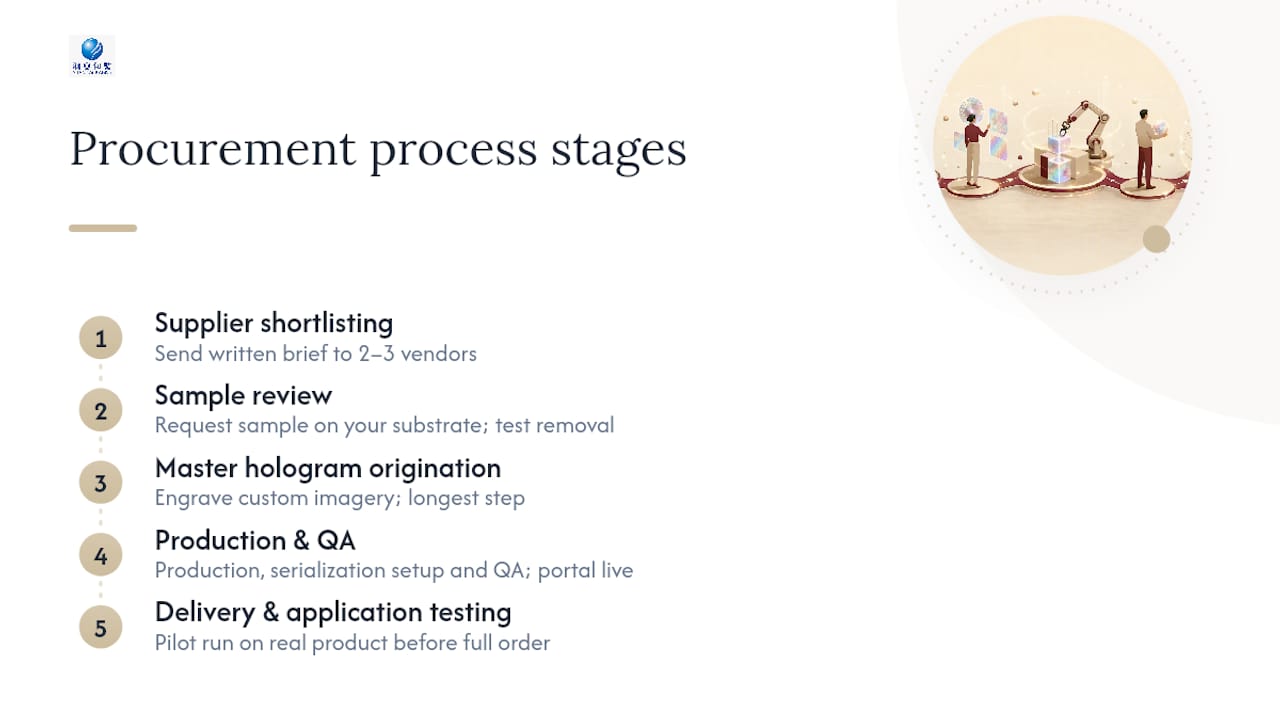
**Stage four** covers production and quality assurance, including serialization setup if you’re using unique IDs or QR integration. This is also when you’d finalize any digital verification portal so it’s live before labels ship. **Stage five** is delivery and application testing, meaning a short pilot run applied to real product before you commit to full-volume ordering.
Treat stage five as non-negotiable even under deadline pressure. A label that performed perfectly in a supplier’s test lab can still behave differently on your actual production line, especially if your application speed or environment differs from their testing conditions.
What Do Hologram Security Labels Actually Cost?
Total cost breaks into three buckets, and brand teams who only budget for the per-unit label price consistently underestimate the real number.
**Design and origination** is the upfront investment: creating your custom hologram imagery and engraving the master. This is a one-time cost, but it’s often the single largest line item on a first order, since a dedicated master origination costs meaningfully more than licensing stock imagery.
**Production cost per unit** depends on the factors covered earlier: security feature complexity, order volume, lamination, and finishing. A basic stock hologram with a simple 2D/3D effect sits at the low end; a custom hologram with covert laser-readable features, serialization, and tamper-void adhesive sits considerably higher.
**Application and integration cost** is the piece teams forget most often. If you’re adding serialization with QR verification, budget for the data infrastructure, whether that’s a hosted verification portal or integration with your existing inventory software. Factor in application equipment or labor if you’re applying labels in-house rather than having your packaging supplier apply them during production.
A useful way to think about total cost: origination is fixed and amortizes across your order volume, per-unit production cost scales with security complexity, and digital verification adds an ongoing cost that continues after the physical labels ship. Ask any supplier to break a quote into these three categories rather than accepting one bundled number, since that’s the only way to compare quotes apples to apples.
How Long Does the Full Rollout Actually Take?
Set expectations early, because master hologram origination is almost always the timeline’s longest single stage, and rushing it is exactly how brands end up with a compromised or easily replicated design.
Sample creation and initial supplier review typically move fastest, since you’re often working from existing capability demonstrations rather than a brand-new design. Master hologram engraving and approval takes considerably longer, particularly for custom imagery with covert or nano-optical features, since the origination equipment and review cycles are more involved than standard print production. Full production, once the master is approved, follows a more predictable schedule tied to your order volume and any serialization setup.
Build your internal timeline backward from a hard launch date, and add buffer specifically around the master origination stage, since that’s where unexpected revision cycles most often occur. Brands running a pilot batch before a full retail rollout should plan for the pilot itself to add real calendar time, not just token testing, since the entire point is catching application or durability issues before they show up at scale.
Yuan Packaging’s Experience and Practical Tips for Buyers
Over many years and countless units delivered across a large number of brands, we’ve watched most anti-counterfeit label problems trace back to two things: rushed artwork approval and unclear security specifications going to suppliers. Prepare final artwork with the holographic zone clearly marked before sample review, since revisions at that stage cost real time. Expect sample approval to involve a physical tamper test, not just a visual check. The rollout approach that consistently works best is a pilot batch with scan analytics before committing to full-volume production, letting you catch application issues on your actual line before they scale into a bigger problem.
_— Anthony_
Request Samples and Technical Specs From Yuan Packaging
A specialized finishing operation handles foil stamping and embossing for beauty and spirits brands, so security features and shelf presence get built together, not bolted on separately.
That matters if you’ve been comparing generic hologram vendors who treat security as an add-on to an existing label line. We work from your specification document, whether that’s the substrate, tamper-evidence requirement, and security tier outlined earlier in this guide, and quote against it directly. Our anti-counterfeit labels combine holographic and serialized security with the sustainable, FSC-certified material sourcing and quality control our broader label production runs on. If your brand also needs matching cosmetic or spirits packaging, our cosmetic label and wine and spirits label lines run through the same production and QA process.
Request a sample pack and technical spec sheet through our anti-counterfeit labels page to see how a custom hologram performs on your actual substrate before you commit to a production run.
Sources
For deeper technical grounding, consult the International Hologram Manufacturers Association for industry guidance, the Wikipedia entry on security holograms for optical fundamentals, and JSTOR’s security hologram search results for academic literature.
FAQ
What Makes a Hologram Label Hard to Counterfeit?
Difficulty comes from the master hologram itself: replicating the diffractive pattern requires specialized origination equipment most counterfeiters lack, and secure custody of that master during production is what industry guidance identifies as the real deciding factor.
Should I Choose Stock or Custom Hologram Labels?
Stock holograms cost less and ship faster but offer no brand-exclusive protection since the imagery isn’t unique to you; custom holograms cost more upfront but tie security directly to your brand through a dedicated master origination.
How Do QR Codes Work With Hologram Labels?
A QR code paired with a serialized ID lets consumers, distributors, or investigators scan a unique code against a verification portal, turning a static visual deterrent into a trackable data point for each unit.
What’s a Reasonable MOQ for Custom Security Holograms?
Minimums vary by supplier and feature complexity, but custom holograms with covert or serialized features typically carry higher minimums than standard stock imagery, since origination cost needs to spread across a larger production run.
Does Yuan Packaging Produce Custom Hologram Security Labels?
Yes. Yuan Packaging’s anti-counterfeit label line includes holographic and serialized security features built through the same specialty finishing and quality control process used across its beauty and spirits packaging production.