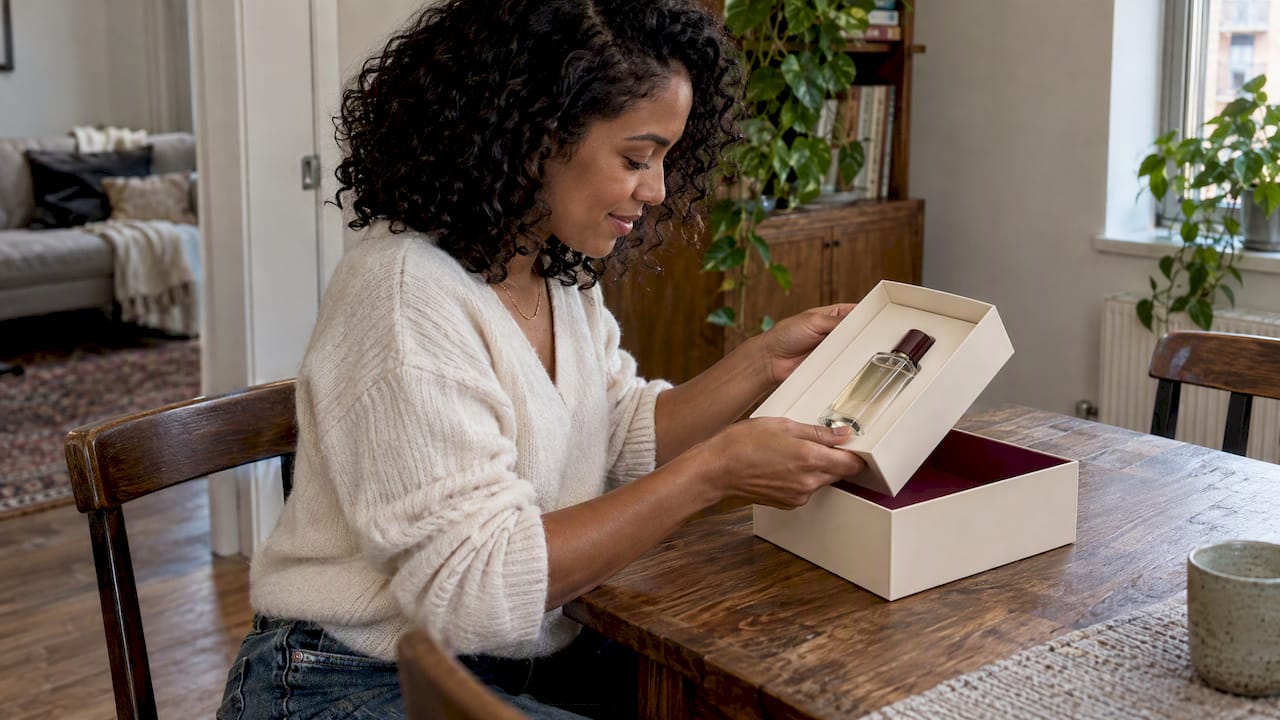
Unboxing experience design is the deliberate planning of every moment between a customer receiving a package and using the product: the outer shipper, the first reveal, the inner structure, the way the product sits, and what happens after the lid comes off. Done well, it turns a delivery into a short, planned sequence of anticipation and discovery. Done badly, it is a crushed corner, too much void fill and a lost chance to say who you are. This guide explains how to design that sequence for premium beauty, spirits, health and lifestyle products, what the research supports, and where cost, protection and recyclability put limits on ambition.
TL;DR
- Design the unboxing as a sequence of reveals (outer box, inner layer, product presentation), and give every layer a job.
- Protection comes first: a damaged product ruins the moment no matter how beautiful the box is.
- Complexity tends to raise quality expectations, but more is not always better. Scent, for example, reduced liking in one 2025 study.
- Choose structure, finish and insert together, then prototype and test with real respondents before committing to a production run.
- Recyclable, right-sized paper-based packaging can still deliver a premium moment when the finish and structure do the work.
Table of Contents
- What an unboxing experience actually is
- What the research says about perception and loyalty
- Build the reveal in layers
- Structure, finish and insert: where the premium feel comes from
- Use the senses with restraint
- Protect the product first
- Sustainability without losing the moment
- Our perspective
- How to test your unboxing design
- From concept to production
- FAQ
- Sources
What an unboxing experience actually is
Amazon's seller guide frames unboxing as the deliberate design of every moment from receipt to product use, with a purpose assigned to each layer: outer box, inner reveal and product presentation. Shopify's description is simpler: it is the moment a customer opens a package and discovers the product, and thoughtful notes and quality materials can make that moment memorable and shareable.
The sharing part is not trivial. Radial reports that YouTube recorded 25 billion unboxing-video views in 2023, and its advice follows from that: design from the outside in, and think about what a viewer sees first when a customer films the opening.
For a premium brand, the useful way to think about it is as a narrative moment with a beginning, a middle and an end:
- Arrival: the shipper or carrier bag signals the brand before it is opened.
- Opening: the lid, drawer, sleeve or flap sets the pace of the reveal.
- Presentation: the product sits where the eye lands, held securely, with accessories arranged on purpose.
- Afterlife: the box is kept, reused or recycled easily, and the customer is given a reason to come back or share.
What the research says about perception and loyalty
Packaging design is often justified with intuition. Several peer-reviewed and academic sources give it firmer footing, though each has limits worth stating plainly.
Complexity shapes expectations. An academic study on rich unboxing experiences found that greater packaging complexity raises product-quality expectations and influences how people appraise the product's personality. The same effect cuts both ways: higher expectations can heighten delight, or disappointment if the product underdelivers.
Complex openings can raise positive feeling and sharing. In a University of Twente master's thesis with 144 respondents, complex rather than simple unboxing produced higher positive affect, and positive affect significantly increased willingness to share online and offline. Positive affect explained 16.7% of the variance in online word-of-mouth, 27.9% in offline word-of-mouth and 16.2% in willingness to pay. A thesis is not a large field trial, so read these as directional evidence, not a guarantee.

The shipping box counts too. A 2020 study in the Journal of Retailing and Consumer Services found that shipping-box aesthetics can increase enjoyment of delivery and carry through to loyalty intentions, depending on customers' expectations and the brand's other touchpoints. In other words, an attractive outer carton helps, but it cannot rescue a weak product or a poor service experience.
Build the reveal in layers
A reveal arc is easier to design when you treat each layer as a separate decision with its own purpose. This is the sequence we recommend working through.
- Define the feeling first. Decide whether the moment should read as ceremonial (a fragrance or spirits gift set), clean and clinical (a regulated health product) or playful (a lifestyle launch). Every later choice should support that.
- Set the outer layer's job. For direct-to-consumer orders, the outer layer must survive parcel transit and still carry brand cues. A branded corrugated e-commerce mailer can handle both, and our guide to corrugated box design, FEFCO styles, flutes and ECT explains how to match strength to the shipping route.
- Choose the opening mechanism. A lid-and-base box opens with a slow lift, a book-style box opens like a cover, and a drawer slides out in one continuous gesture. Each sets a different tempo. See the options for lid and base rigid boxes, book-style hinged boxes and drawer boxes.
- Add a second reveal. A printed sleeve, a tissue wrap, a tag or a card under the lid gives the customer something to discover before the product itself. A custom printed sleeve can hold a pattern or message that is revealed as it slides away.
- Present the product deliberately. Orient it so the label or logo faces the person opening, hold it with a fitted insert, and arrange accessories in the order they will be used.
- Close the loop. A short card, a QR code to usage content or a reorder prompt gives the moment somewhere to go. Keep it relevant and short.
Pro tip: sketch the sequence as a storyboard of six frames before touching a dieline. If a frame has no purpose, remove it.
Structure, finish and insert: where the premium feel comes from
The tactile side of unboxing is decided mainly by structure, finish and insert working together, with the carrier bag and label carrying it further. Treat them as one decision, not separate purchases.
| Element | What it does for the experience | Where to look |
|---|---|---|
| Rigid structure | Weight, rigidity and a controlled opening speed | Rigid box design rules |
| Surface finish | Touch, light and contrast: soft-touch lamination, foil stamping, embossing, blind embossing | Packaging finishes and print effects |
| Insert | Holds the product, frames it and prevents movement | Five box insert options |
| Carrier bag | Extends the moment to retail or gifting | Paper carrier bags |
| Label | Precision, authenticity and, where needed, anti-counterfeit features | Custom labels |
A few practical notes on each:
- Finish contrast beats finish quantity. A matte soft-touch surface with a single foil-stamped mark reads as more confident than four effects competing. Reserve embossing or blind embossing for the one element you want fingers to find.
- The insert is part of the reveal. A well-cut insert makes the product appear to rise into view, and it also reduces transit damage and waste. Our guide to box inserts compares the main options.
- Drawer boxes need discipline. They look premium, but the pull tab, tolerance and sleeve fit determine whether the opening feels smooth. We cover this in drawer box packaging that looks premium.
- Check current direction before locking a look. Our review of gift box design trends shows where premium retail packaging is heading.
If you are choosing between a rigid box and a lighter board option, rigid box vs folding carton lays out the trade-offs on cost, feel and shipping weight.
Use the senses with restraint
Multisensory design is tempting: add a scent, a texture, a sound. The evidence says be selective. A 2025 study in Scientific Reports tested identical chocolate in boxes varying by color, texture, scent and opening method. Interaction, color, texture and scent shaped perceptions and responses. A snail-fold opening produced higher price expectations than a slide-and-tilt opening, and when scent was present, the snail-fold box also drew higher willingness to pay than the lift-off and slide-and-tilt openings. Yet scent reduced overall liking, which the researchers discussed as possible hedonic overload.
The practical reading is this: the opening mechanism and the touch of the material are safe levers, and scent needs careful testing on a small sample before it ships. This is especially true in beauty, where the product itself may already be fragranced and a competing scent in the box would muddy the first impression.
Protect the product first
A flawless reveal collapses if the item arrives damaged. ISTA, the transport packaging body, notes that transit damage harms consumer experience and brand equity and that preventing damage avoids replacement shipments. Its ISTA 3L protocol simulates e-commerce hazards such as vibration, shock, compression, temperature, humidity and drops from varying heights. For items sold through large marketplaces, ISTA's 6-Amazon.com Over Boxing overview describes a test that evaluates the package and product together against parcel-delivery vibration and shocks.
What this means for design:
- Test the full assembly (outer carton, rigid box, insert and product), not the pretty box alone.
- If a rigid gift box ships inside a mailer, specify the mailer so the inner box cannot shift or scuff.
- For spirits and glass, give insert geometry as much attention as artwork.
- For regulated and pharmaceutical products, make sure the opening experience does not conflict with safety features. Tamper-evident cartons and seals can be part of a well-paced reveal, with the seal break as the first deliberate step.
Sustainability without losing the moment
Consumers notice waste at the unboxing. Packaging Insights reported that US shoppers' e-commerce packaging preferences include minimizing empty space, avoiding styrofoam and QR-enabled content, and that Mondi found 90% of European consumers prefer recyclable, correctly sized e-commerce packaging. Note that the second figure describes European consumers, not American ones.
The ECR design-for-recycling guidance sets out a clear order of priority: avoid packaging waste first, then reuse, then recyclable design, while assessing the best choice across the whole life cycle and the local recovery infrastructure. Its recommendations also include reducing material without compromising protection, favoring mono-materials or compatible combinations, using recycled content where possible, choosing adhesives and inks that do not hinder recycling, and making component separation easy or unnecessary.
The industry is treating this as a design constraint rather than a trade-off. The Paperboard Packaging Alliance's 2026 design challenge asks for an engaging, memorable unboxing moment alongside protection, manufacturability, cost effectiveness and broad residential recyclability, with a 100% paper-based package containing at least 70% paperboard.
In practice:
- Right-size the box so nothing needs filler.
- Replace plastic windows, trays and laminations with paper-based alternatives where the product allows.
- Put the premium cues into structure, print and finish rather than extra layers.
- Ask your manufacturer which finishes affect recyclability, and decide before artwork is final.
Our perspective
After more than 25 years of making labels, rigid boxes and carrier bags for beauty, spirits and lifestyle brands, we have seen the same pattern: the best unboxing moments are rarely the most expensive ones. They are the ones where someone decided what the customer should feel, then made every component serve that feeling.
We would put it this way. Start with the product and the transit route, not the artwork. Pick one signature gesture, such as a slow-lifting lid, a drawer that glides or a label with a crisp foil edge, and protect it from compromise. Then let the supporting pieces stay quiet. Our approach combines hand finishing with modern automated production in a single facility, which matters here because structure, print, finish and insert are specified and checked together, so the sample you approve is the box that arrives.
We also believe the reveal should respect regulation. A pharmaceutical carton and a perfume gift set follow different rules, and the best designs make compliance part of the rhythm rather than an afterthought.
— Anthony
How to test your unboxing design
Do not rely on internal taste. The academic study on rich unboxing experiences used a straightforward method that brands can borrow: prototype three packaging designs of varying complexity and collect participant responses on ten bipolar semantic-differential scales to measure product expectations and appraisal.
A practical version for a brand team:
- Build three prototypes: a simple option, a mid-level option and a complex option, with the same product inside.
- Recruit real customers, not colleagues, ideally from the segment you sell to.
- Score each opening on paired opposites such as cheap to luxurious, ordinary to distinctive, or disappointing to delightful.
- Ask about sharing and price: would they post it, and what would they expect to pay? The Twente findings suggest these move together with positive feeling.
- Run the transit test on the winner, then adjust structure or insert before production.
- Watch the returns data after launch. Damage and complaint rates tell you whether the reveal is working in the real world.
A complex design wins on feeling in the research, but your sample may show diminishing returns at a point. Let the data decide where the extra cost stops paying back.
From concept to production
If you are ready to turn a reveal concept into samples, we manufacture the full range this guide describes, from custom rigid gift boxes and folding cartons to labels, carrier bags, paper tubes and corrugated e-commerce boxes. Our work covers more than 100 million units delivered to 5,000 brands, with finish options such as foil stamping, embossing and soft-touch lamination. Browse the full product range or contact us to brief us on structure, material and finish. For beauty brands, our guide to custom rigid gift boxes for cosmetics is a good starting point.
FAQ
What is an unboxing experience?
It is the planned sequence a customer goes through when receiving and opening a package, from the outer box to the final presentation of the product. Each layer is given a purpose so that anticipation builds and the product feels discovered. It includes materials, structure, print, inserts and any extras such as notes or cards.
Does a better unboxing experience really change what customers do?
The research points that way, with caveats. A University of Twente master's thesis with 144 respondents linked more complex unboxing with stronger positive feeling and greater willingness to share, and a 2020 retail study found shipping-box aesthetics can raise delivery enjoyment. Effects depend on customer expectations and the rest of the brand experience, so test before you invest heavily.
How do I balance a premium unboxing with sustainability?
Start by removing what is unnecessary: right-size the box, avoid mixed materials and choose recyclable, paper-based components where the product allows. Then put the premium feel into structure, print and finish. Check inks, adhesives and coatings with your manufacturer so that they do not hinder recycling.
Should I add scent or other sensory extras?
Test carefully before adding them. In a 2025 study, scent improved willingness to pay in one box format but reduced overall liking, possibly through sensory overload. Opening mechanism and material touch are lower-risk ways to engage the senses.
Sources
- Radial: unboxing and how you make customers feel
- Rich unboxing experiences: complexity in product expectations (Inderscience)
- Ceciel Berden, University of Twente master's thesis
- Conditional enjoyment-enhancing effect of shipping box aesthetics (ScienceDirect)
- Effects of multisensory packaging on taste perception (Scientific Reports)
- ISTA 3L e-commerce packaging test announcement
- ISTA 6-Amazon.com Over Boxing overview
- ECR packaging design for recycling guidance, 2024
- Paperboard Packaging Alliance 2026 design challenge
- Packaging Insights: top packaging trends 2026
Recommended
- Gift Box Design Trends Shaping Premium Retail in 2026
- Drawer Box Packaging That Looks Premium and Meets 4evergreen and ECMA
- Skincare Box Design That Inspires and Survives Production
- Production Ready Luxury Fragrance Box Design for Brand Teams
What is an unboxing experience?
It is the planned sequence a customer goes through when receiving and opening a package, from the outer box to the final presentation of the product. Each layer is given a purpose so that anticipation builds and the product feels discovered. It includes materials, structure, print, inserts and any extras such as notes or cards.
Does a better unboxing experience really change what customers do?
The research points that way, with caveats. A University of Twente master's thesis with 144 respondents linked more complex unboxing with stronger positive feeling and greater willingness to share, and a 2020 retail study found shipping-box aesthetics can raise delivery enjoyment. Effects depend on customer expectations and the rest of the brand experience, so test before you invest heavily.
How do I balance a premium unboxing with sustainability?
Start by removing what is unnecessary: right-size the box, avoid mixed materials and choose recyclable, paper-based components where the product allows. Then put the premium feel into structure, print and finish. Check inks, adhesives and coatings with your manufacturer so that they do not hinder recycling.
Should I add scent or other sensory extras?
Test carefully before adding them. In a 2025 study, scent improved willingness to pay in one box format but reduced overall liking, possibly through sensory overload. Opening mechanism and material touch are lower-risk ways to engage the senses.