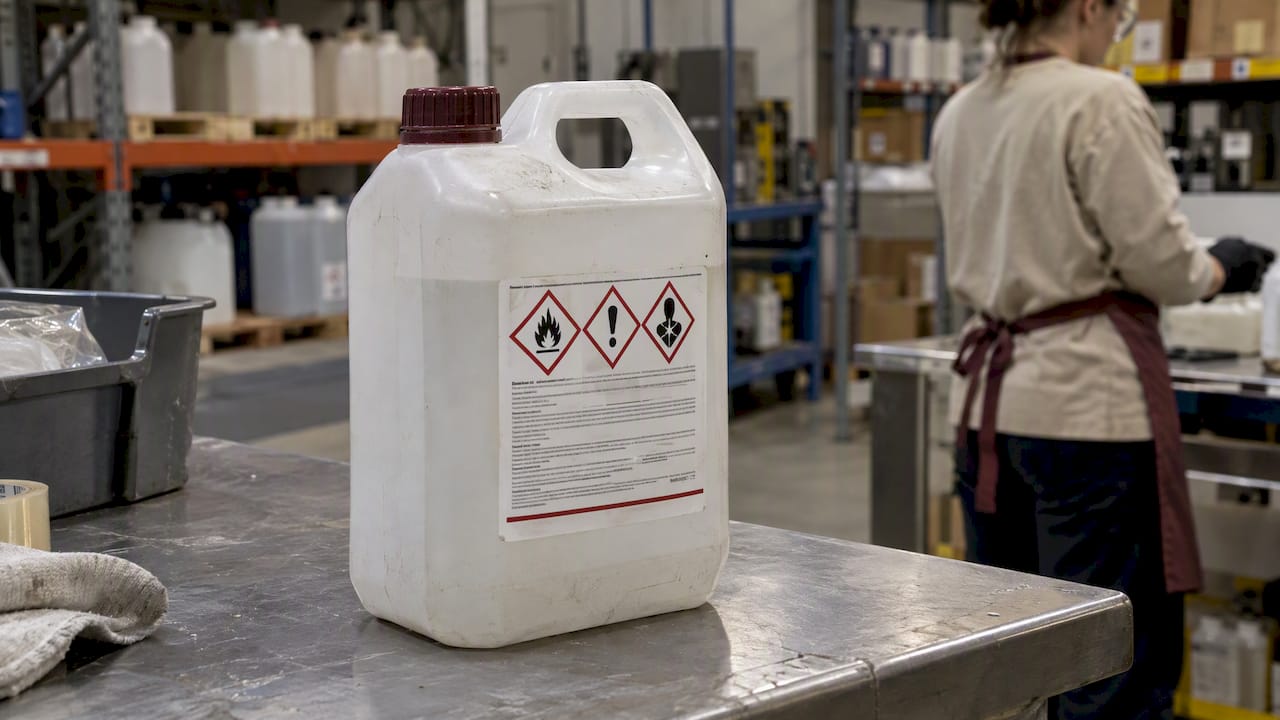
A GHS-compliant label in the United States carries six elements: a product identifier, a signal word, pictograms, hazard statements, precautionary statements, and the name, address and phone number of the responsible company. The rules come from OSHA's Hazard Communication Standard (HCS), which was updated in 2024 to align with the seventh revision of the GHS. This guide explains each element and the points where labels most often go wrong: pictogram format, small containers, shipping and export, and the EU's separate CLP rules. It closes with what to put in a brief to your label printer.
TL;DR
- Every shipped container of a hazardous chemical needs six label elements under OSHA's HCS: product identifier, signal word, pictograms, hazard statements, precautionary statements and supplier identification.
- OSHA's updated HCS took effect on July 19, 2024, and added provisions for labeling small containers.
- GHS is a framework, not a single law. The US (OSHA), the EU (CLP) and transport rules (DOT, UN) each apply it differently, so one label design may not serve every market.
- Internal workplace labels can use alternatives such as HMIS or NFPA. Once a container leaves your site, it needs the full label.
- Treat the label as a printed component: specify material, adhesive, ink and finish for the conditions it will live in, and proof the layout before the run.
Table of Contents
- What GHS is, and who enforces it in the US
- The six required label elements
- Label size and layout: what the US does and does not say
- Workplace labels versus shipped container labels
- Shipping, DOT and export
- The EU: CLP and the UFI
- Print specification: briefing your label printer
- Common mistakes to avoid
- Our perspective: treat the label as a regulated component
- Labels and cartons built to your regulatory brief
- FAQ
- Sources
What GHS is, and who enforces it in the US
The Globally Harmonized System of Classification and Labelling of Chemicals (GHS) is a United Nations framework. It defines how chemical hazards are classified and how they are communicated through labels and safety data sheets. It does not carry legal force on its own. Each country decides what to adopt.
OSHA describes GHS as a building block approach rather than a model standard to adopt word for word. Regulators choose the parts that suit their sector. For US workplaces, that choice is the Hazard Communication Standard, 29 CFR 1910.1200. The 2024 final rule conforms the HCS primarily to GHS Revision 7, and OSHA later issued correction notices, the first on October 9, 2024, fixing errors in the regulatory text and appendices that affect labels and safety data sheets. Check the current text of 1910.1200 before you finalize artwork, because the corrections touch label content.
Who must label? Chemical manufacturers, importers and distributors are responsible for making sure each container leaving their hands is labeled. Employers who receive containers must keep those labels intact and legible.
The six required label elements
OSHA's Appendix C sets out the elements for a shipped container. Here they are in the order a reader scans them.
| Element | What it is | Practical note |
|---|---|---|
| Product identifier | The chemical name, code or batch number, matching the safety data sheet | Use the exact identifier from the SDS so the two documents can be cross-referenced |
| Signal word | "Danger" for more severe hazards, "Warning" for less severe | Only one signal word appears on a label |
| Pictograms | Standardized hazard symbols | Red frame on a white background, matched to the classification |
| Hazard statements | Standard phrases describing the nature of the hazard | Assigned by hazard class and category |
| Precautionary statements | Measures to prevent or respond to exposure | Cover prevention, response, storage and disposal |
| Supplier identification | Name, address and telephone number of the manufacturer, importer or other responsible party | Must be a real contact point |
The format rules for pictograms matter to anyone designing the artwork. Appendix C requires pictograms to sit on a white background within a red frame, wide enough to be clearly visible, and matched to the specific hazard classification. A decorative black border or a colored fill does not meet the standard.
Legibility, language and durability
Labels must be legible, in English, and firmly attached to the container. Employers with workers who speak other languages may add that information, as long as the English remains. Because the label has to stay readable throughout the container's use, adhesion, abrasion resistance and chemical resistance are compliance questions, not just production details. We return to that in the print specification section below.
Label size and layout: what the US does and does not say
The US sets no minimum label size. The text must simply be legible, as summarized by a GHS practitioner blog. In practice, that leaves the judgment to you, and an auditor will judge legibility by eye.
The EU is stricter. CLP sets minimum sizes in Annex I, section 1.2.1.4: for packages up to 3 liters, the label should be at least 52 x 74 mm if possible, with pictograms not smaller than 10 x 10 mm and, if possible, at least 16 x 16 mm. For packages above 3 liters and up to 50 liters, the label must be at least 74 x 105 mm with pictograms of at least 23 x 23 mm. If you sell into both markets, design to the EU dimensions where the container allows. A label sized that way also meets the US requirement, which asks only that the text be legible.

Small containers
Small vials, ampoules and tubes are where the layout problem is hardest. The 2024 update added provisions for small container labeling. As the regulation text puts it, the paragraph applies where a manufacturer, importer or distributor can demonstrate that pull-out labels, fold-back labels or tags carrying the full label information are not feasible. Read the paragraph in full before relying on it. The first answer is a pull-out or fold-back label, or a hang tag carrying the complete information. Reduced content is a fallback you must be able to justify.
Pro tip: If a product ships in small vials inside a carton, put the complete label information on the carton and a fold-back label on the vial, then confirm with your compliance lead which container OSHA treats as the immediate container for your use case.
Workplace labels versus shipped container labels
A common source of confusion is the difference between a label for a container that ships and one used inside your facility.
OSHA's interpretation letter on intra-plant labeling explains that workplace labeling under 1910.1200(f)(6) and (f)(7) applies to chemicals used within the workplace. It allows alternative systems such as HMIS or NFPA, provided they deliver equivalent hazard information. Once a container leaves for another site, it is a shipped container and needs the full GHS/HCS label.
This matters for private-label and contract-fill arrangements. If your product is filled at one site and moved to another before sale, assume the full label is needed at the point of transfer, and confirm with your regulatory advisor.
Shipping, DOT and export
GHS and DOT labels on one container
GHS pictograms and transport labels are different things. UNECE explains that workplace GHS pictograms carry a red border, while transport labels follow the UN Model Regulations for dangerous goods. They are not interchangeable.
The two systems can share a container. The joint PHMSA and OSHA memorandum explains that the DOT Hazardous Materials Regulations generally prohibit labels that conflict or confuse, but HCS-compliant labels are excepted. A single combined label is acceptable if all required GHS elements are present and clear. OSHA's 2021 interpretation addresses the same question of combining DOT and HCS requirements on one label. Supplemental information, such as a California Proposition 65 warning, must not obscure the mandatory hazard information. Where a DOT-required pictogram appears on a shipped container, 1910.1200(f)(5) addresses how it relates to the GHS pictogram, so check that paragraph when you design a combined label.
If your shipment includes goods that carriers restrict, the carrier's rules apply on top of all this.
Exports and imports
For sealed containers shipped directly for export, OSHA's interpretation allows labeling to follow the destination country's requirements, provided the outer shipping container is appropriately marked. If the sealed container is opened at an intermediate US warehouse, individual inner containers must be brought into HCS compliance immediately. Importers carry responsibility for incoming containers, and that responsibility begins when they take control of the container.
The EU: CLP and the UFI
If you also sell in Europe, GHS means CLP (Regulation 1272/2008). A revised CLP entered into force in December 2024. It allows digital labeling in some cases to improve legibility and will require hazardous properties to be shown clearly on online store pages. Industry obligations generally apply from July 1, 2026. Regulation (EU) 2025/2439 then moved the online store requirement and the new label formatting rules from their original dates (July 1, 2026 and January 1, 2027) to January 1, 2028. Existing stock placed on the market before January 1, 2027 has a grace period until January 1, 2029. A wider EU chemicals simplification package is not yet finally adopted and may change these rules again, so confirm the timeline for your product category against the current legal text. The 16-character Unique Formula Identifier (UFI) on labels for hazardous mixtures is older than the revision: it comes from CLP Annex VIII and was phased in from 2021 to 2025.
The UFI links the product on the shelf to the formulation held by national poison centers. The European Commission's poison centre page describes it as a way to reduce over-treatment in medical emergencies. For a label designer, the UFI is one more fixed-length field to place, print crisply and, where relevant, keep out of the varnish zone.

Print specification: briefing your label printer
Compliance text is only useful if it prints sharply, stays attached and survives the container's life. Give your printer these inputs.
- Final label text and pictograms, approved by your regulatory lead. The printer is not the classifier. The chemical manufacturer or importer is responsible for classification and for label content.
- Container dimensions and curvature. Provide the surface, the diameter and the usable label area, so the dieline reflects what will physically fit.
- Exposure conditions. State whether the label meets solvents, moisture, abrasion, cold storage or sunlight.
- Substrate, adhesive and finish. Choose face material, adhesive and any laminate for those conditions. Matte or gloss varnish should never cover a field that needs to be scanned or written on.
- Variable data. Batch numbers, lot codes, UFIs and QR links often change per run. Plan for serialized or variable data from the start.
- Proof and sample approval. Check pictogram red values, frame thickness and the smallest text size on a physical proof, not only on screen.
Key takeaway: the smallest legible type on your label is set by the worst reading condition, not the best. Test the proof under warehouse lighting.
For how we approach batch codes and serial fields, see our notes on track and trace labels that survive lamination. For incoming quality checks on a delivered run, our guide to packaging quality control with ISO 2859 and AQL sets out sampling methods that apply to labels as well as cartons.
Common mistakes to avoid
- Using the wrong pictogram frame. Transport diamonds and GHS pictograms look similar, but they are different formats. Use the one the regulation requires for that container.
- Hiding mandatory information under supplemental warnings. A Prop 65 notice or marketing copy must not obscure the hazard information.
- Letting the label drift from the SDS. The product identifier and hazard statements should match the current safety data sheet. Revisit both whenever the classification changes.
- Ignoring the update cycle. The HCS was amended in 2024 and corrected afterwards. Labels designed to the 2012 version may need review.
- Treating the outer carton as the label. The immediate container must carry its own label unless an exception applies.
- Overlooking durability. A compliant design on a label that smudges or peels is a non-compliant label in the field.
Our perspective: treat the label as a regulated component
We have spent over 25 years producing labels, cartons and rigid boxes for brands in beauty, spirits, health, food and retail, and the pattern is consistent. Regulatory failures on packaging are rarely about a missing sentence. They come from the handoff between the person who owns the content and the person who owns the print file.
Our advice has three parts. First, lock the text with your regulatory lead before artwork begins, and let the printer own legibility, not classification. Second, decide the physical conditions early: a label that must survive handling, moisture and abrasion needs a different construction from one on a retail shelf. Third, ask for a physical proof and approve it against the safety data sheet, line by line.
Because we manufacture labels, cartons and bags under one roof, a regulated product can have its primary label, its outer carton and its shipping case coordinated in one project instead of three. That simplifies the question of which container carries which information. Whether a label is mandatory or optional is always your regulatory advisor's call, not ours. What we control is that what you approve is what gets printed.
— Anthony
Labels and cartons built to your regulatory brief
If you are specifying labels for a regulated product, our custom label printing covers pressure-sensitive formats, and our variable data and serialized labels handle batch codes and lot numbers. For anti-counterfeit features, see our anti-counterfeit labels. Health and pharmaceutical brands can also review our pharmaceutical carton range. Send us your container dimensions, exposure conditions and approved artwork, and we will work from your brief. You can browse everything we make on our products page.
FAQ
What information does OSHA require on a hazard communication label?
A label on a shipped container must show the product identifier, a signal word, pictograms, hazard statements, precautionary statements, and the name, address and phone number of the manufacturer, importer or other responsible party. These are listed in OSHA's Appendix C. The text must be legible and in English.
Is there a minimum label size under US GHS?
No. The US specifies no minimum label size, only that the information be legible. The EU does set minimum dimensions under CLP, depending on package capacity. If you sell in both markets, designing to the EU dimensions where the container allows is the safer route.
Can I use HMIS or NFPA labels instead of GHS labels?
Only inside your own workplace. OSHA's interpretation allows alternative systems for internal labeling if they communicate equivalent hazard information. A container that leaves for another site is a shipped container and needs the full GHS/HCS label.
Can a GHS label and a DOT label be combined?
Yes, under conditions. The joint PHMSA and OSHA memo says a single label works if every required GHS element is present and clear, and supplemental information does not obscure the hazard information. Confirm the details for your shipment with your transport compliance team.
Do the 2024 HCS changes affect existing labels?
They can. The final rule took effect on July 19, 2024, and revised classification criteria and small container labeling. Review your labels against the current regulation text and the later corrections, ideally with your regulatory advisor.
Sources
- OSHA Hazard Communication Standard, Appendix C: allocation of label elements
- OSHA final rule, Hazard Communication Standard (May 20, 2024)
- OSHA correction notice for the HCS final rule
- OSHA 29 CFR 1910.1200, Hazard Communication
- OSHA final rule preamble (March 26, 2012), building block approach
- OSHA interpretation: intra-plant and intercompany shipping labels
- Joint PHMSA and OSHA memorandum on hazard communication
- OSHA interpretation: single HCS label with DOT requirements
- OSHA interpretation: HCS labeling of imports and exports
- UNECE: GHS labels and pictograms
- European Commission: revised chemical labelling regulation enters into force
- Regulation (EC) No 1272/2008 (CLP), consolidated text: Annex I, section 1.2.1
- Regulation (EU) 2025/2439: new application dates for the revised CLP
- European Commission: poison centres and the UFI
- Label size requirements under US GHS
Recommended
- Avoid 1/16 Inch Failures: FDA Cosmetic Label Rules for U.S. Brands
- Track and Trace Labels That Survive Lamination for Regulated Brands
- Pharmaceutical Carton Requirements: Braille, FMD, Leaflets
What information does OSHA require on a hazard communication label?
A label on a shipped container must show the product identifier, a signal word, pictograms, hazard statements, precautionary statements, and the name, address and phone number of the manufacturer, importer or other responsible party. These are listed in OSHA's Appendix C. The text must be legible and in English.
Is there a minimum label size under US GHS?
No. The US specifies no minimum label size, only that the information be legible. The EU does set minimum dimensions under CLP, depending on package capacity. If you sell in both markets, designing to the EU dimensions where the container allows is the safer route.
Can I use HMIS or NFPA labels instead of GHS labels?
Only inside your own workplace. OSHA's interpretation allows alternative systems for internal labeling if they communicate equivalent hazard information. A container that leaves for another site is a shipped container and needs the full GHS/HCS label.
Can a GHS label and a DOT label be combined?
Yes, under conditions. The joint PHMSA and OSHA memo says a single label works if every required GHS element is present and clear, and supplemental information does not obscure the hazard information. Confirm the details for your shipment with your transport compliance team.
Do the 2024 HCS changes affect existing labels?
They can. The final rule took effect on July 19, 2024, and revised classification criteria and small container labeling. Review your labels against the current regulation text and the later corrections, ideally with your regulatory advisor.