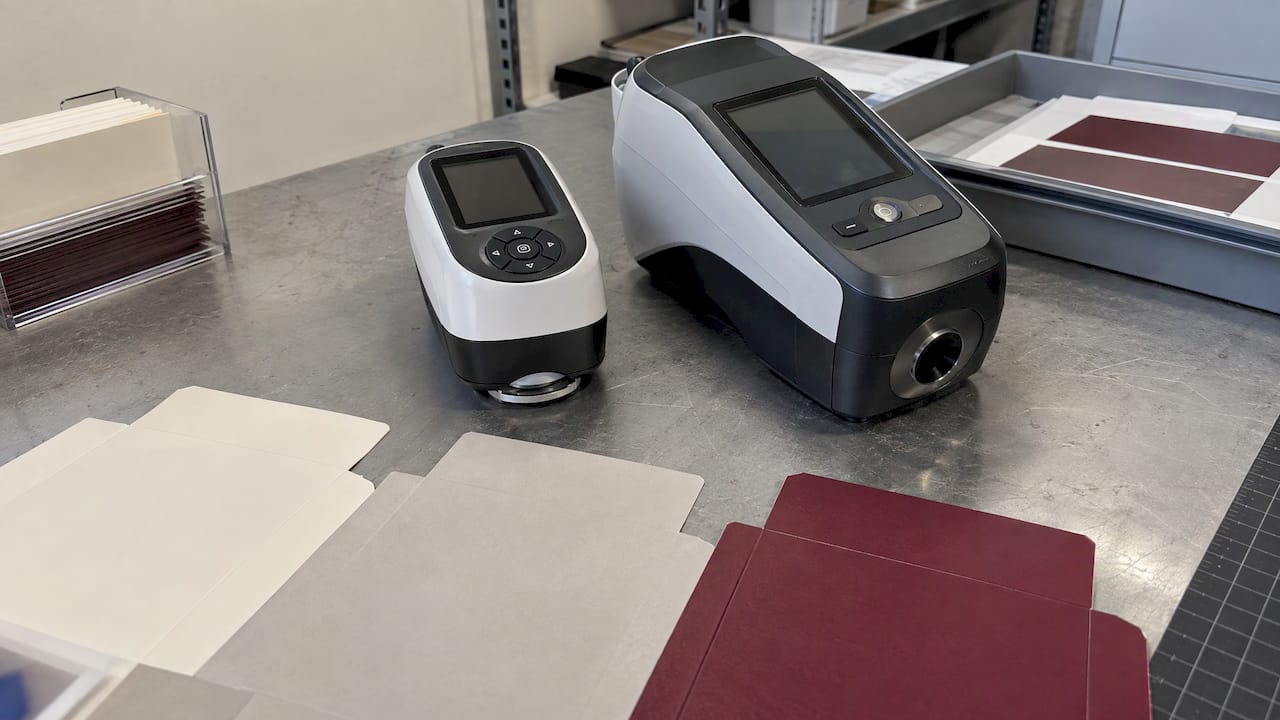
A colorimeter reads color through three filtered sensors and reports one set of values. A spectrophotometer measures reflected light wavelength by wavelength and keeps the full spectral curve. For routine pass/fail checks on stable materials, a colorimeter is enough. For matching a master across batches, substrates or lighting conditions, you need a spectrophotometer. This guide explains the difference in practical terms, shows where packaging work falls on each side, and covers what two well-known brands, X-Rite and Datacolor, offer.
TL;DR
- A colorimeter uses three filtered channels to produce tristimulus values (X, Y, Z) for one light source and one observer condition.
- A spectrophotometer records spectral reflectance, so it can calculate color for many illuminants and detect metamerism.
- Choose a colorimeter for fast, repeatable consistency checks; choose a spectrophotometer for color matching, formulation and supplier approval.
- Geometry matters too: 45°:0° suits smooth or matte surfaces, while sphere instruments suit mirror-like metallic or deeply textured ones.
- Whatever you buy, a color number means little without its stated measurement conditions.
Table of Contents
- How each instrument measures color
- Spectrophotometer vs colorimeter at a glance
- Which is more accurate?
- When a colorimeter is enough
- When you need a spectrophotometer
- Geometry and surface: the choice inside the choice
- X-Rite vs Datacolor
- A simple decision path
- Our perspective
- Bring your color standard to production
- FAQ
- Sources
How each instrument measures color
The colorimeter: three channels, one answer
A tristimulus colorimeter measures reflected light through three filters designed to approximate the CIE x, y and z responses of the eye, and it outputs three tristimulus values directly, according to Konica Minolta's technical explanation. In other words, it imitates how a human observer responds, then stops there. X-Rite's color guide describes the same idea: a colorimeter imitates the eye to calculate RGB-type values that can be converted into a three-dimensional color system.
The practical consequence is that a colorimeter produces tristimulus notation for only one measurement light and one observer condition, the ones its filters simulate, as Quality Magazine's overview of colorimetry puts it. That is a perfectly good answer when the question is narrow: has this batch drifted from the last one?

The spectrophotometer: the full spectral fingerprint
A spectrophotometer separates reflected light into its wavelengths and measures spectral reflectance across the visible range before calculating tristimulus values. Konica Minolta's instrument team describes a typical range of 400 to 700 nm measured at fixed wavelength intervals, producing a complete spectral fingerprint of the sample.
Because that curve is retained, color values can be calculated after the fact. Datacolor notes that, unlike colorimeters, spectrophotometers can identify metamerism, perform color formulation and simulate different illuminant and observer conditions. Konica Minolta's reference material adds that a color meter gives numerical data in various color spaces, while a spectrophotometer provides the same numerical data plus a spectral-reflectance graph.

Is a spectrophotometer a type of colorimeter?
Not in the sense that matters when you are buying. The two are distinct technologies that both serve color measurement. The wording is genuinely confusing, though. A 2026 paper in the journal Color Research & Application by John Seymour notes that the meaning of the word has drifted over time, and that modern devices often bear little resemblance to historical colorimeters while still serving the goal of emulating human color perception. In chemistry labs, the word is often used for absorbance-measuring instruments that gauge concentration rather than color. Spectrophotometers for packaging are a different tool from the lab absorbance meters, so check the product page before you assume.
A related but unrelated word: a calorimeter measures heat. It has nothing to do with color.
Spectrophotometer vs colorimeter at a glance
| Criterion | Colorimeter | Spectrophotometer |
|---|---|---|
| What it measures | Three filtered channels (X, Y, Z) | Spectral reflectance across the visible range |
| Light and observer conditions | One, fixed by the filters | Many, calculated from stored spectral data |
| Metamerism detection | No | Yes |
| Color formulation and colorant strength | Not appropriate | Suitable |
| Speed and cost | Generally faster and more affordable | Higher cost, more capability |
| Best for | Routine QC, pass/fail checks | Matching to a master, supplier approval, color-critical work |
The cost and speed row comes from HunterLab's guidance, which describes colorimeters as generally more affordable and faster to operate and well suited to routine quality control. The capability rows follow Konica Minolta's own comparison, which says a spectrophotometer suits complex analysis such as metamerism and colorant strength.
Which is more accurate?
In most comparisons the spectrophotometer wins, and much of the reason is data. Because it keeps the spectral curve, color-space coordinates can be recalculated after measurement, and the instrument is more versatile.
Two cautions keep that claim honest:
- Geometry shapes the result. Comparability between two readings depends on the optical geometry, meaning the angles of illumination and detection. NIST lists illumination and viewing geometry among the sources of measurement uncertainty for spectroreflectometers.
- A number needs its conditions. A NIST paper stresses that measurement geometry is one of the most important conditions to specify, and that uncertainty depends on the measurement conditions as well as the instrument. Calibration, reference standards, bandwidth and instrument characteristics all feed into uncertainty.
So two different spectrophotometer models, or a spectrophotometer and a colorimeter with different geometries, can report slightly different values for the same sheet. When a brand and its packaging supplier compare numbers, they should agree on the instrument model, geometry, illuminant, observer and tolerance in writing.
When a colorimeter is enough
A colorimeter fits when raw materials are stable and matching to a physical master is not required. Konica Minolta's guidance describes colorimeters as mainly used in production and inspection for color-difference and color-chart measurement. Typical cases:
- Checking that a roll or lot has not drifted from the previous lot of the same material.
- Pass/fail checks at goods-in or on the line, where speed matters more than depth.
- Non-uniform samples such as food or wood, where a larger aperture helps average the surface. The Konica Minolta blog notes colorimeters may be preferred for these samples.
Pro tip: a colorimeter works best as a comparison tool. Set a reference reading from an approved sample, then measure everything against that reference with the same instrument.
When you need a spectrophotometer
The spectrophotometer earns its price when any of these apply:
- Matching across batches or substrates. A brand color printed on coated paper, uncoated board and a laminated label will look different on each, and spectral data lets you see why.
- Metamerism. Two samples that match under showroom light can diverge under store lighting or daylight. Of the two instruments, only a spectrophotometer reliably reveals it.
- Formulation. Mixing inks or checking colorant strength depends on reflectance curves.
- Multiple illuminants. Retail, e-commerce photography and outdoor display all use different light.
- Supplier approval. When you send a color standard to a manufacturer on another continent, spectral data is the shared, objective reference. Datacolor describes spectral data as a fingerprint of the color that never changes for the object.
For premium beauty and spirits packaging, where a foil, a soft-touch laminate and a printed Pantone often sit side by side, this is usually the deciding factor. If you are setting tolerances for those finishes, our guides on Pantone matching tolerances and proofing and on keeping a logo color identical across Pantone and CMYK show how proofs and ΔE targets turn into purchase specifications.
Geometry and surface: the choice inside the choice
Once you decide on a spectrophotometer, the next question is geometry. X-Rite's print and packaging guide explains that 45°:0° instruments such as the eXact 2 suit smooth or matte surfaces, while sphere instruments such as the Ci64 suit mirror-like metallic or deeply textured surfaces.
For packaging, this maps neatly onto materials:
- Matte printed cartons and paper labels: 45°:0° is the natural fit.
- Mirror-like metallic board or foil printed with translucent inks, and deeply textured stock: a sphere geometry copes better.
- Laminated surfaces: gloss changes how much light returns to the sensor, so measure with the same geometry the other party uses. Our comparison of matte vs gloss lamination explains how finish affects perceived color.
X-Rite vs Datacolor
Both brands make instruments across the range, and both publish good technical material. X-Rite offers spectrophotometers such as the eXact 2 for print and packaging (45°:0°) and the sphere-based, handheld Ci64 for diverse surfaces. Datacolor's portable range includes the sphere-based Spectro P200, and its Techkon brand makes the SpectroDens 4 spectrodensitometer for pressrooms. Datacolor's Spyder line serves a different job, monitor and display calibration.
| X-Rite | Datacolor | |
|---|---|---|
| Example instrument | Ci64 handheld sphere spectrophotometer | Spectro P200 portable sphere spectrophotometer |
| Typical use | Measuring printed and packaged goods | Production color quality control |
Treat the table as a starting point rather than a verdict. Both makers sell portable sphere and 45°:0° spectrophotometers, so the model matters more than the brand. For a head-to-head decision, compare the specific models you are shortlisting on geometry, aperture size, reporting software and whether your supplier already reads data from the same family of instruments.
A simple decision path
- Define the question. Is it "has this changed?" or "does this match the master?" The first favors a colorimeter, the second a spectrophotometer.
- List your substrates and finishes. Several materials point to spectral data; mirror-like foils or deeply textured stock point to a sphere geometry.
- Check who else needs to read the numbers. If your packaging supplier, printer or brand owner uses a given instrument family, compatibility saves arguments.
- Write the conditions into the spec. Illuminant, observer, geometry, ΔE formula and tolerance, all stated.
- Verify at the source. Approve a physical sample and a measured reference together, then keep both on file.
The same logic applies to inspection plans. Our guide to packaging quality control, ISO 2859 and AQL shows where color measurement fits among the other tests, and our walkthrough on qualifying a packaging supplier in China covers how to build color expectations into supplier onboarding.
Our perspective
In packaging, the instrument is only half of the story. We have produced over 100 million units for 5,000 brands across 25 years, and the color conversations that go smoothly always start the same way: a defined standard, a stated tolerance and one agreed way of measuring.
Our approach combines traditional hand-finishing with modern automated manufacturing under a single facility, and that matters for color. When printing, foil stamping, embossing and lamination are coordinated in one place, you can tie a color target to the finished surface the customer actually holds, not just to a flat printed swatch.
Our advice to brand teams is practical. Use a colorimeter-grade check for routine consistency, use spectral data when the color is a brand asset, and always specify the measurement conditions in the purchase documents. That gives your buyer, your designer and your manufacturer one shared language.
Anthony
Bring your color standard to production
If your color target is settled and you need it carried onto rigid boxes, labels or cartons, we can work from your standards across structure, material and finishing, including foil stamping, embossing and soft-touch lamination. Share your reference and tolerance with us at the start of a project, and we will plan the print and finishing around them.
Browse our custom packaging product lines, or look at the pages most relevant to color-critical work: custom labels, folding cartons and rigid gift boxes.
FAQ
Is a spectrophotometer a colorimeter?
Not in the usual buying sense. They are distinct technologies that both measure color. A colorimeter reports tristimulus values through three filters, while a spectrophotometer measures the full spectrum and calculates tristimulus values from it. The confusion comes from the history of the word colorimeter, which has been used loosely, including for absorbance meters in chemistry.
What is another name for a colorimeter?
You will see color meter and tristimulus colorimeter, and some makers use chromameter. Check the specifications: if the product measures spectral reflectance across wavelengths, it is a spectrophotometer, whatever the name on the box.
Which is better for packaging color matching?
A spectrophotometer, in most cases. Matching across substrates, finishes and lighting conditions depends on spectral data, and metamerism cannot be reliably measured without it. Colorimeters remain useful for fast routine checks once a standard is already approved.
Does the measurement geometry really change the result?
Yes. Illumination and viewing geometry are recognized sources of measurement uncertainty, and glossy, metallic or textured surfaces react differently to 45°:0° and sphere instruments. Agree on one geometry with your supplier and record it with every reading.
Sources
- Comparing colorimeters and spectrophotometers, Part III (Konica Minolta)
- Differences between tristimulus method and spectrophotometric method, Part II (Konica Minolta)
- Precise Color Communication (Konica Minolta)
- Spectrophotometers vs. Colorimeters: Tools for traceable color (Konica Minolta Sensing)
- X-Rite Color Guide and Glossary
- Measurement Techniques in Colorimetry (Quality Magazine)
- Color measurement techniques in colorimetry (Datacolor)
- What Is the Difference Between a Colorimeter and a Spectrophotometer? (HunterLab)
- What's the Difference Between a Colorimeter, a Colorimeter... (Color Research & Application, 2026)
- CIE Fundamentals for Color Measurements (NIST)
- Choosing a Spectrophotometer for Print and Packaging (X-Rite)
- Datacolor Spectro P200 portable spectrophotometer (Datacolor)
- SpectroDens 4 spectrodensitometer (Techkon, a Datacolor brand)
Recommended
- Keep Logo Color Identical: Pantone, CMYK, and ΔE≤2 for Packaging Teams
- Pantone Matching for Packaging: Tolerances and Proofing
Is a spectrophotometer a colorimeter?
Not in the usual buying sense. They are distinct technologies that both measure color. A colorimeter reports tristimulus values through three filters, while a spectrophotometer measures the full spectrum and calculates tristimulus values from it. The confusion comes from the history of the word colorimeter, which has been used loosely, including for absorbance meters in chemistry.
What is another name for a colorimeter?
You will see color meter and tristimulus colorimeter, and some makers use chromameter. Check the specifications: if the product measures spectral reflectance across wavelengths, it is a spectrophotometer, whatever the name on the box.
Which is better for packaging color matching?
A spectrophotometer, in most cases. Matching across substrates, finishes and lighting conditions depends on spectral data, and metamerism cannot be reliably measured without it. Colorimeters remain useful for fast routine checks once a standard is already approved.
Does the measurement geometry really change the result?
Yes. Illumination and viewing geometry are recognized sources of measurement uncertainty, and glossy, metallic or textured surfaces react differently to 45°:0° and sphere instruments. Agree on one geometry with your supplier and record it with every reading.